XR in Construction & Safety
Construction and heavy industry has one of the highest workplace injury rates of any sector. When I first started exploring XR applications in the energy and industrial space, the gap between how safety training was delivered and how effective it actually was struck me immediately. Reading a manual or watching a video about what to do when a valve fails is nothing like actually doing it — even in a simulated environment. That gap is exactly what XR closes.
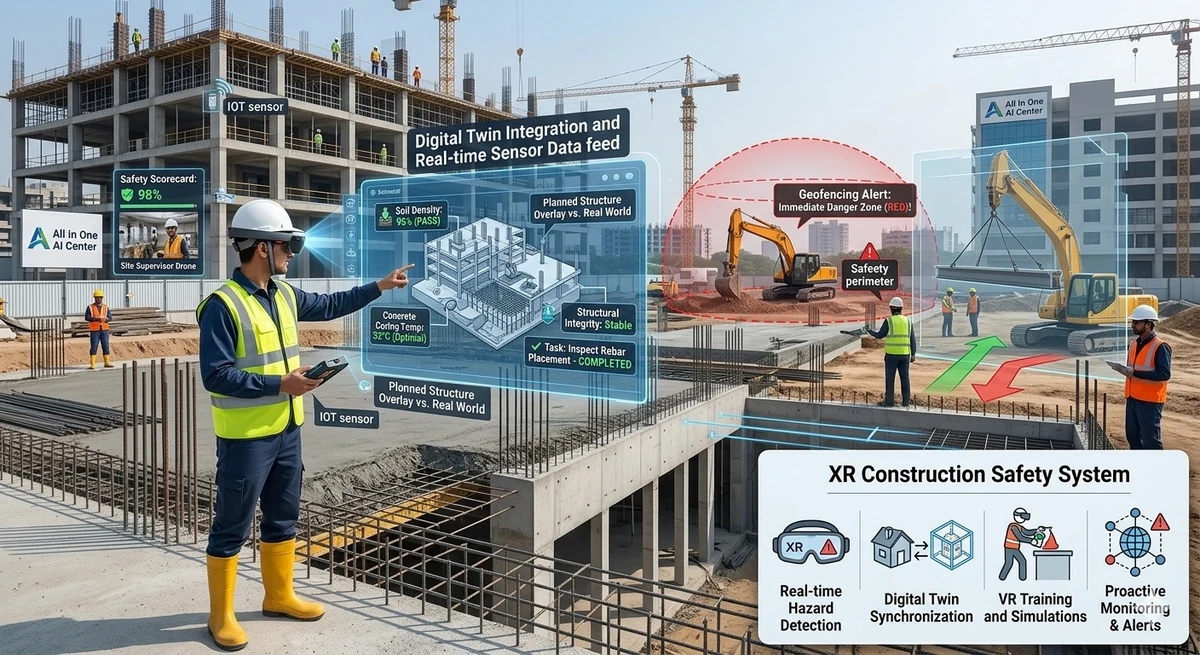
Why Traditional Safety Training Falls Short
The standard approach — classroom instruction, printed procedures, occasional site walk-throughs with a supervisor — creates workers who know the theory but have no muscle memory for the reality. You cannot safely simulate a gas leak, a scaffold collapse, or an electrical fault in a real facility for training purposes. The cost and risk are too high. So workers go into real emergency situations having never experienced anything close to them.
VR changes this completely. I can put a worker inside a photorealistic construction site or industrial facility, trigger a realistic hazardous scenario, and let them make mistakes — and learn from those mistakes — in total safety. The simulation can run as many times as needed, on any device, without any risk to anyone. Performance can be logged, scored, and reviewed by supervisors remotely.
What VR Safety Training Actually Looks Like in Practice
The VR safety training systems I've built and worked with typically cover three core areas. Hazard identification — workers navigate a virtual environment and must identify safety violations, missing PPE, exposed equipment, and procedural failures before they cause an incident. Procedure training — step-by-step interactive workflows for tasks like valve operations, pressure checks, lockout/tagout procedures, and emergency equipment use. Emergency response — timed scenarios where workers must execute correct procedures under simulated pressure, with realistic audio and visual stress cues.
The key differentiator from watching a video is that the worker is physically doing it. They reach out, grab the valve, turn it in the correct direction. Their hands — or rather, their controllers — actually perform the action. Motor memory develops in a way that passive instruction never achieves. Research from PwC consistently shows VR training delivers significantly higher knowledge retention than classroom-based alternatives.
AR for Live Site Guidance
Beyond VR training simulations, augmented reality has a separate and growing role on actual construction sites. AR overlays — delivered through headsets or increasingly through mobile devices — can display live safety checklists, highlight hazard zones, show underground utility maps overlaid on the real ground, and provide step-by-step procedural guidance without requiring a worker to look away from their task. The challenge with AR in construction environments is durability and practicality — current headset hardware is not always suited to dusty, high-temperature, or physically demanding site conditions. This is an area where the technology is maturing fast.
Key Use Cases in Construction & Safety
- Pre-task safety briefings in VR — walk the entire crew through a new site layout before anyone sets foot on it
- Scaffold and height-work training — acclimate workers to working at height in a safe environment, reducing hesitation and improving procedure adherence
- Fire and evacuation drills — run evacuation simulations for complex multi-floor sites without disrupting actual work
- Equipment operator training — practice crane, excavator, and heavy machinery operation without the liability of real equipment
- Incident investigation — reconstruct past incidents in VR to understand contributing factors and train teams on what went wrong
Technical Considerations When Building for Construction XR
Construction and industrial XR projects have some specific technical demands I've encountered. Photorealism matters more than in entertainment — if the virtual site does not look and feel like the real environment, the training value drops because workers mentally disconnect from it as "just a game." This means significant investment in environment art, realistic lighting, and accurate equipment modelling.
Performance optimisation for standalone VR headsets is also more demanding when environments are large and detailed. Industrial facilities tend to be large spaces with complex geometry. Getting these running at 72fps or above on a Meta Quest requires aggressive LOD systems, occlusion culling, texture atlasing, and sometimes baked lighting rather than real-time. It is solvable but requires deliberate technical planning from the start of the project, not as an afterthought.
Have an XR project in mind?
I've delivered XR solutions across oil & gas, healthcare, government, and corporate sectors in the UAE and beyond. If you're exploring what XR could do for your organisation — whether a proof of concept, a full training simulator, or something entirely new — I'm happy to have a conversation.
Get in touch → or explore the full XR portfolio.