XR in Education & Training
Education is one of the areas where XR has the clearest, most research-backed case for adoption. The problem with most instruction — classroom, video, even interactive e-learning — is that it is passive. The learner receives information but does not do anything with it in a high-fidelity way. XR changes the fundamental dynamic: instead of being told how something works, you experience it. And experience, as any educator or trainer will tell you, is what actually forms lasting memory.
Kids Learning in VR — Why It Works
One of the most compelling applications of VR in education is for children — and the research behind it is consistent. Children learn by doing far more effectively than by watching or reading. VR takes that principle and amplifies it: instead of looking at a picture of Saturn, a child flies through the rings. Instead of reading about Ancient Rome, they walk its streets. The experience engages spatial memory, emotional engagement, and active participation simultaneously — the three strongest drivers of long-term retention.
The Science Behind It
Studies on immersive learning consistently show that VR produces retention rates 3× higher than passive learning (lecture, video, or reading). A 2020 PwC study found VR learners were 4× faster to train than classroom learners and 275% more confident applying skills afterwards. For children specifically, the engagement factor is even more pronounced — the immersive novelty captures attention in a way that no screen or textbook competes with, particularly for children who struggle with traditional learning formats.
What Kids Actually Experience in a VR Classroom
A well-designed VR learning experience for children looks nothing like a digitised textbook. It is spatially designed, interactive, and timed to the natural attention span of the age group. A 7-year-old exploring the solar system in VR is not watching a video — they are piloting a spacecraft, collecting data from planets, and making decisions that affect the simulation. That active agency is what drives learning outcomes.
Subject areas where VR has shown the strongest results for children include:
- Science — visiting the surface of Mars, exploring the inside of a cell, witnessing the water cycle from inside a cloud. Abstract concepts become spatially tangible.
- History — walking through Ancient Rome, the streets of the Indus Valley civilisation, or a World War II airfield. Historical empathy and context that no photograph can provide.
- Biology and health — exploring the human body from inside, understanding how organs function, what viruses look like at cellular scale. Comprehension rates in VR are 83% vs 45% with diagrams.
- Mathematics and spatial reasoning — manipulating 3D geometric shapes, exploring number relationships spatially. Particularly powerful for children who struggle with abstract numerical concepts.
- Language learning — being immersed in the cultural context of a language, interacting with virtual characters in that language, rather than repetitive written exercises.
The Teacher's Role in a VR Classroom
Effective VR education does not replace the teacher — it frees them. While students are immersed in experiences that would be impossible to deliver physically, the teacher monitors engagement in real time, reviews performance data, identifies which students are struggling with which concepts, and uses that data to inform the next lesson. This is a fundamentally different kind of teaching relationship — data-informed, personalised, and focused on the moments where human intervention adds the most value.
From my own experience building VR for Vax-e-KIDS (a paediatric immunisation project): even children as young as 4-5 years old adapt to VR interaction within seconds. The spatial instinct is immediate. What surprised me most was not the engagement — that was expected — but how quickly the fear response to the injection was genuinely displaced. The brain's presence response in VR is real, measurable, and clinically significant even in very young children.
The Knowledge Retention Argument
PwC's widely cited VR training study found that learners completed VR training four times faster than classroom learners, felt 275% more confident applying what they learned, and showed significantly higher emotional engagement with the material. These are not marginal improvements — they represent a fundamental shift in how effectively information transfers when the learning modality is immersive rather than passive.
From my own work building training simulations — particularly the VR gas safety training simulator showcased at GITEX Dubai 2024 — I have seen this translate into measurable outcomes. Workers who trained in VR made fewer procedural errors during assessments than those who received only classroom instruction. The difference was not subtle. When you have physically performed a task — even in a virtual environment — your response in the real situation is qualitatively different from having only read about it.
Where XR Works Best in Education
XR is not a universal replacement for traditional education. It excels in specific contexts where the gap between instruction and experience is largest, and where that gap has significant consequences.
Dangerous or High-Stakes Procedures
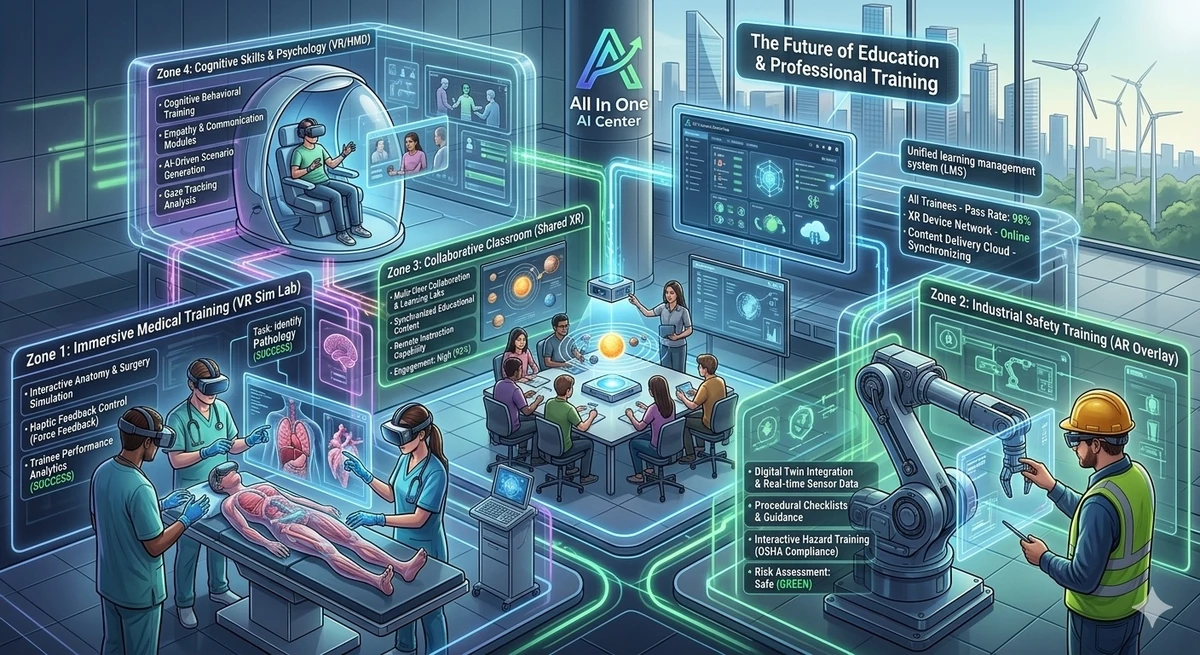
Medical training, surgical simulation, aviation, defence, industrial safety — anywhere that practising the real thing carries genuine risk, VR provides a consequence-free environment to build competence before the stakes are real. A surgical trainee can perform a procedure dozens of times in VR before their first real case. A pilot can experience engine failure scenarios that would be impossibly dangerous to rehearse in real aircraft.
Rare or Inaccessible Scenarios
Some educational experiences are impossible to provide physically — visiting the surface of Mars, witnessing a historical event, examining the interior of a working nuclear reactor. VR makes these accessible. This is particularly powerful in science, history, and engineering education, where abstract concepts become tangible when experienced spatially.
Soft Skills and Behavioural Training
One area that surprised me when I first encountered it was soft skills training — leadership, public speaking, difficult conversations, unconscious bias. These are areas where traditional role-play exercises often feel contrived and where participants hold back because the environment does not feel real enough to trigger genuine emotional responses. VR scenarios involving virtual humans can be remarkably effective here precisely because the brain, to some extent, treats the interaction as real even when consciously aware it is not.
Corporate Learning & Development
Beyond formal education, corporate L&D is arguably where XR is seeing the most rapid adoption right now. Large organisations with distributed workforces — retail, logistics, manufacturing, financial services — can deploy consistent, high-quality training at scale using VR in a way that is simply not possible with instructor-led training. Once a VR training module is built, the marginal cost of deploying it to an additional 1,000 employees is essentially zero. That changes the economics of quality training dramatically.
The onboarding use case is particularly compelling. Bringing new employees into a realistic representation of their workplace — even virtually — before their first day creates familiarity and confidence that has measurable effects on early retention and time-to-productivity. I built a multi-user metaverse onboarding platform for a government organisation in the UAE along exactly these lines, and the feedback from new joiners was consistent: it reduced the anxiety and disorientation of starting a new role in an unfamiliar environment.
Technical Reality: What XR in Education Actually Requires
Building effective educational XR is harder than it looks. The biggest mistake organisations make is thinking that putting content into VR automatically makes it more effective. A bad e-learning module rebuilt as a VR experience is still a bad learning experience — just more expensive. The instructional design has to be fundamentally reimagined for the immersive medium. Learners cannot just watch — everything has to be interactive and purposeful.
From a technical standpoint, educational XR also has to be reliable above all else. Entertainment VR can tolerate occasional crashes or glitches; training environments used repeatedly across different users and device configurations need to be robust and consistent. Thorough testing across target hardware — and designing for the lowest-spec device in your deployment — is essential from day one of development.
Have an XR project in mind?
I've delivered XR solutions across oil & gas, healthcare, government, and corporate sectors in the UAE and beyond. If you're exploring what XR could do for your organisation — whether a proof of concept, a full training simulator, or something entirely new — I'm happy to have a conversation.
Get in touch → or explore the full XR portfolio.