XR in Manufacturing
Manufacturing is one of the sectors where XR has moved most decisively from proof-of-concept to genuine operational use. The economics are straightforward: in manufacturing, errors are expensive. A worker who makes a mistake during assembly, quality inspection, or maintenance — because they were inadequately trained, or because they could not see the relevant information at the right moment — costs real money. XR addresses this by making training more effective and by delivering information to workers exactly when and where they need it on the factory floor.
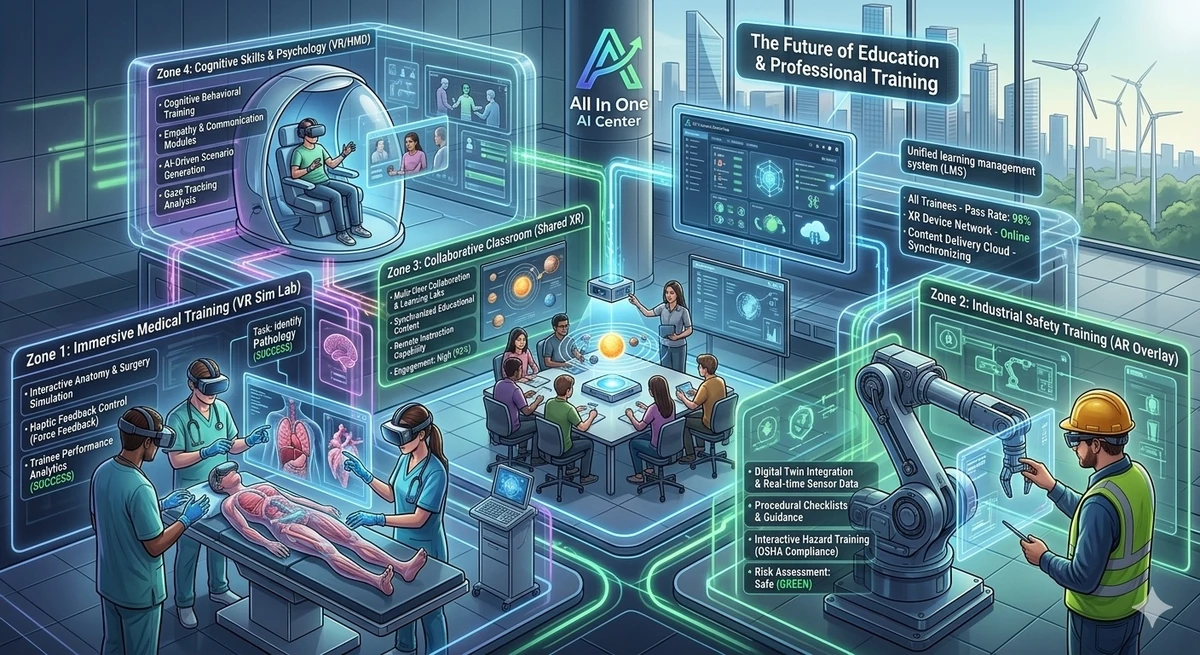
Assembly Training and Procedure Guidance
Complex assembly procedures have traditionally been trained through a combination of classroom instruction, printed manuals, and supervised on-the-job experience. The problem with manuals is that they require a worker to repeatedly look away from what they are doing to check the next step. The problem with supervised OJT is that it is expensive and inconsistent — the quality of training depends entirely on the supervisor's availability and their approach on that particular day.
VR assembly training solves the first problem by letting workers practice complete assembly procedures in a virtual environment before touching real components. They build the muscle memory and procedural awareness without the cost of scrapping real parts during the learning process. AR guidance — displaying the next step overlaid directly onto the physical component being assembled — solves the second problem by providing consistent, always-available guidance that does not require looking away from the work.
Digital Twins and Factory Floor Simulation
The concept of a digital twin — a real-time virtual replica of a physical asset or environment — is particularly powerful in manufacturing. A digital twin of a production line allows engineers to test process changes, identify bottlenecks, and plan maintenance windows entirely virtually before touching the physical line. For large manufacturers where even a few minutes of unplanned downtime costs tens of thousands of dollars, the ability to simulate and validate changes before implementing them has obvious value.
Building accurate digital twins requires precise 3D scanning of physical assets, integration with live sensor data from the production environment, and careful physics simulation. In Unity, which is my primary development platform, this involves combining photogrammetry pipelines, IoT data integration, and real-time simulation systems. It is technically demanding but the capability has reached a level of maturity where enterprise deployment is practical.
Quality Control and Inspection
AR has a specific and growing role in quality control. By overlaying inspection criteria, measurement tolerances, and defect detection guidance directly onto physical components in the worker's field of view, AR can reduce both the time required for inspection and the error rate. Computer vision integration — where the AR system automatically identifies potential defects and flags them — is advancing rapidly, though the technology works best in controlled lighting environments with consistent part geometry.
For inspection tasks with regulatory requirements — such as the tanker inspection simulation I built for ADIPEC Abu Dhabi 2025 — VR training with AI-guided procedural walkthroughs ensures that inspectors know every step of the required protocol and can be assessed against it in a standardised way before conducting real inspections. This has clear compliance and liability implications for companies in regulated industries.
Remote Assistance and Expert Knowledge Capture
One of the more immediately practical XR applications in manufacturing is remote AR assistance — a technician on the factory floor wearing AR glasses or using a mobile device shares their live view with a remote expert, who can annotate the live view to guide them through a repair or unfamiliar procedure. This has significant value for organisations with specialist knowledge concentrated in a small number of people, or for multinational manufacturers where experts cannot always travel to where problems occur.
Related to this is the challenge of knowledge capture — as experienced engineers and technicians retire, their procedural knowledge and troubleshooting instincts often leave with them. XR systems that guide workers through procedures step-by-step, and that log how tasks are actually performed by experts, provide a mechanism for capturing and scaling that institutional knowledge.
Current Limitations and Honest Caveats
Manufacturing environments are physically demanding for XR hardware. Dust, heat, electromagnetic interference, and the need to wear PPE alongside XR devices create real challenges. Current consumer AR headsets are not well-suited to many factory floor environments. Ruggedised options exist but come at significant cost. Mobile AR — using tablets or smartphones rather than headsets — is often a more pragmatic starting point for manufacturers exploring the technology for the first time.
Have an XR project in mind?
I've delivered XR solutions across oil & gas, healthcare, government, and corporate sectors in the UAE and beyond. If you're exploring what XR could do for your organisation — whether a proof of concept, a full training simulator, or something entirely new — I'm happy to have a conversation.
Get in touch → or explore the full XR portfolio.