AI-Powered Surveillance in China — Inside the World's Most Advanced Monitoring State
📅 May 27, 2026⏱ 14 min read✍️ Prabhu Kumar Dasari🏷️ AI & Society · China · Privacy
Prabhu Kumar Dasari
Senior XR & AI Systems Developer · 13+ Years · AllInOneAICenter
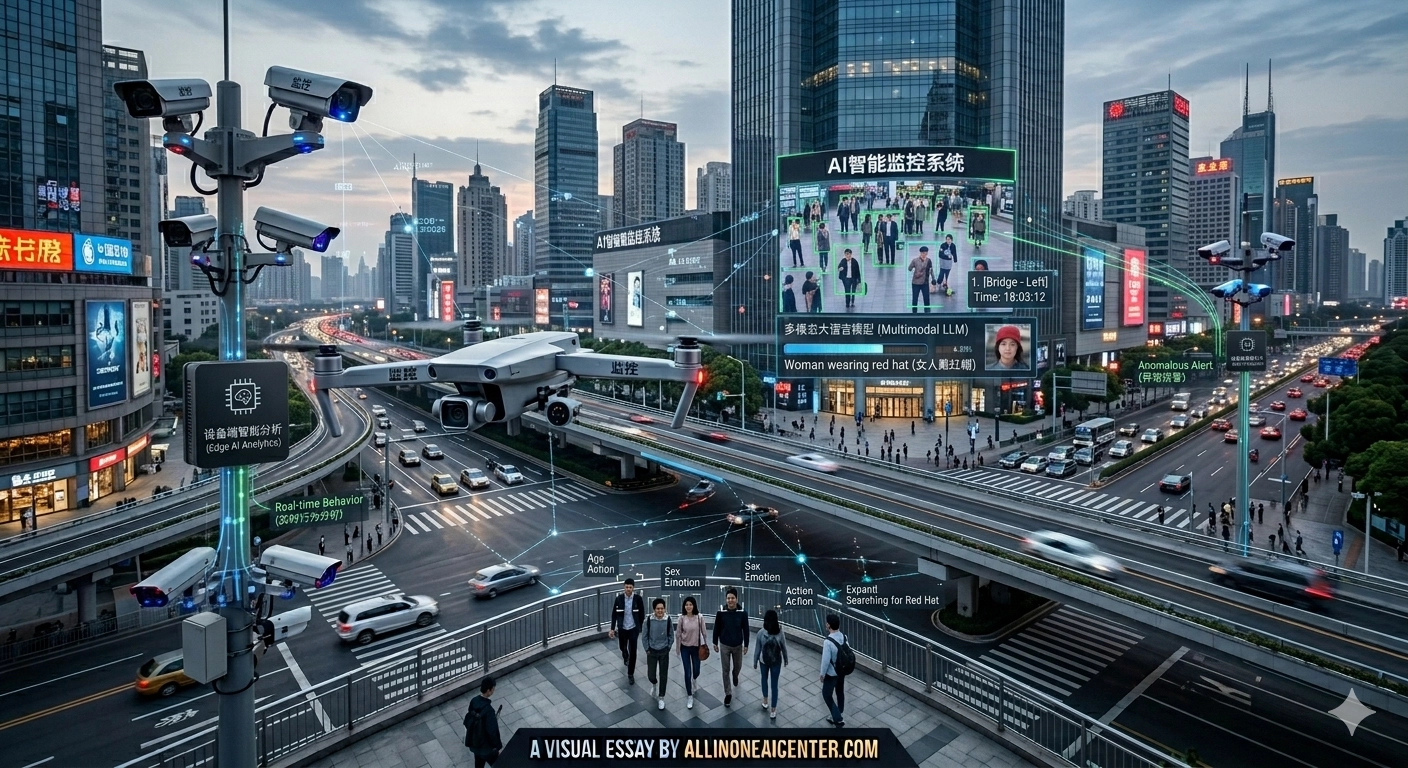
China has built the most sophisticated AI surveillance infrastructure in human history — and it is still accelerating. More than 700 million cameras blanketing public space. Facial recognition accurate to 99.8% under optimal conditions. A gait recognition system that identifies you from 50 metres away, even when your face is covered. Predictive policing algorithms that flag individuals before any crime is committed. And a social credit apparatus that can restrict your freedom to travel, borrow, or work based on AI-scored behaviour. This is not a future scenario. It is operational today. Here is a complete technical and geopolitical breakdown — what exists, how it works, who built it, and why the rest of the world is paying attention.
📊 The Numbers That Define the Scale
To understand China's surveillance infrastructure, you have to start with the raw numbers — because no verbal description adequately captures the density of coverage that has been built since the government's first mass deployment in 2004.
The 700 million camera figure — roughly one camera for every two people — sounds almost abstract until you consider what it means at street level. In Shenzhen, cameras are mounted every 100 metres on major roads. In Xinjiang, coverage is total: cameras inside mosques, restaurants, petrol stations, and even some homes. In Shanghai's financial district, the density rivals that of any major city's airport security zone. But the cameras themselves are only the input layer. The intelligence is in what processes the feed.
📡 Infrastructure Reality Check
By 2025, China's camera network generated an estimated 2.5 exabytes of video data per day — more than the entire global internet traffic in 2010. Storing, transmitting, and analysing this at scale requires a purpose-built AI compute infrastructure that has no equivalent anywhere else in the world. The processing doesn't happen in a single centre. It runs on distributed edge AI chips mounted directly in the cameras, with cloud layers reserved for cross-camera correlation and identity matching.
🏗️ The Architecture — Three Government Programmes That Built This
China's AI surveillance state was not built in one go. It emerged from three distinct government programmes layered on top of each other over two decades, each one expanding what the previous one could see.
🌐
Project Skynet (天网工程) — Launched 2004
Fully Operational
The foundational layer. Skynet was conceived as a national CCTV network connecting cameras across public spaces — transport hubs, commercial districts, and government facilities. By 2010 it covered most major cities. By 2015, it had integrated basic facial recognition. By 2020, it was running deep-learning identity matching in real time across interconnected city-level databases. Today Skynet functions as the backbone — the hardware layer that subsequent programmes use as their sensing substrate. It is operated jointly by the Ministry of Public Security and local governments, with a unified interface that allows central authorities to query any node in the network.
👁️
Sharp Eyes (雪亮工程) — Launched 2015
Fully Operational
Sharp Eyes extended Skynet's reach into rural China — villages, small towns, and county-level jurisdictions that the original programme missed. But more significantly, it introduced a social dimension: residential cameras in housing compounds were connected to the government network, and community watch committees were given tablet access to monitor feeds in their neighbourhoods. The phrase "Sharp Eyes" is a deliberate reference to a Mao-era slogan about the power of the masses to watch each other. It is not subtle. By 2022, Sharp Eyes had connected over 400 million cameras in non-urban zones. The effect was a total elimination of camera-blind zones across most of the country.
🧠
Social Credit System (社会信用体系) — Piloted 2014, Expanding
Expanding Nationwide
The Social Credit System is widely misrepresented in Western coverage as a single unified score. The reality is more complex — and in some ways more unsettling. It is a distributed set of rating systems operated by different agencies, including local governments, financial regulators, and courts, that use AI-processed behavioural data to determine access to services. The camera network feeds into it — but so do phone records, financial transactions, court records, online activity, and community reports. A low score can result in restrictions on purchasing plane or train tickets, enrolling children in fee-paying schools, or obtaining business licences. A high score unlocks preferential treatment in visa applications, credit access, and government contracting. It is already operational across 43 cities and expanding.
🔬 The Technology — What the AI Actually Does
The cameras are not the interesting part. The interesting part is the AI layer that transforms raw video into structured, actionable intelligence about individual people. Five distinct AI capabilities drive China's surveillance apparatus.
👤
Facial Recognition at Scale
Deployed · 99.8% accuracy (ideal conditions)
The core capability. China's national ID database — which covers 1.4 billion people — is integrated with the camera network, allowing real-time identity matching across the country. The matching is not just face-to-database. Cross-camera correlation tracks an individual's movement across a city over time, building a location history that can be queried retrospectively. If you were at a protest six months ago, the system can place you there today. The algorithms used by Hikvision, Dahua, and SenseTime have been trained on datasets that include ethnic Uyghur face data — a fact that triggered significant international scrutiny and US export controls starting in 2019.
🚶
Gait Recognition
Deployed in Major Cities
Developed primarily by Watrix, a Beijing-based AI company, gait recognition analyses the way a person walks — stride length, arm swing, posture — to identify them at distances of up to 50 metres, without requiring a clear view of the face. It works from above, in poor lighting, and even when subjects are wearing masks or hoods. The system was deployed operationally in Beijing and Shanghai before 2020 and has since expanded. The technical limitation is accuracy — it currently runs at around 94% — but at the scale of a city, that still means thousands of daily identifications with no facial data required.
🚨
Predictive Policing AI
Deployed · Methodology Disputed
China's "Integrated Joint Operations Platform" (IJOP) in Xinjiang is the clearest example of predictive policing AI in active use anywhere in the world. It aggregates location data, relationship maps, financial transactions, prayer frequency, and travel history to generate a risk score for individuals. People flagged by IJOP have been detained without charges. The system has been described by human rights organisations as a tool specifically designed to pre-criminalise religious and political expression. Outside Xinjiang, predictive policing AI is used in other provinces to forecast property crime hotspots and identify individuals with outstanding warrants — a less politically sensitive application that more closely mirrors similar systems used in the US and UK.
🎙️
Voice and Emotion Recognition
Piloting
Several Chinese provinces have piloted AI systems that analyse voice patterns from phone calls and audio recordings to detect emotional states — stress, deception, dissatisfaction with government. A 2023 procurement document from a Henan province police bureau described purchasing an "emotion recognition AI system" for use in public security operations. The scientific validity of emotion AI is heavily contested — multiple peer-reviewed studies have found it performs at near-random accuracy on cross-cultural datasets — but the Chinese government has continued procurement despite this. Voice biometrics for identity verification (as opposed to emotion analysis) is more technically mature and is deployed in banking and telecoms.
🧬
DNA-to-Face Phenotyping
Research to Deployment
Perhaps the most unsettling capability: AI systems that generate a probable facial reconstruction from a DNA sample. Developed by labs connected to the Chinese Academy of Sciences, this technology allows investigators to build a visual profile of a person from biological material alone — before any camera image exists. Published research papers by Chinese institutions on DNA facial phenotyping increased 400% between 2018 and 2024. BGI Genomics, the world's largest genomics company, has collected DNA samples from Tibetan and Uyghur populations, raising concerns about how this data interacts with surveillance systems.
"You are not running from the camera. You are running from the database that the camera feeds into — and that database has been accumulating for twenty years."
🏢 The Companies Building It
China's surveillance AI is not a government-only enterprise. It has been built through a public-private partnership model that directs enormous state procurement budgets toward a handful of domestic AI champions, creating a commercial feedback loop that accelerates capability development.
Hikvision
World's largest camera manufacturer
42% state-owned. Hikvision cameras account for an estimated 38% of all CCTV cameras globally. Its AI chips and edge-inference cameras are the primary hardware in China's Skynet and Sharp Eyes networks. On the US Entity List since 2019. Revenue: $14B (2024).
Dahua Technology
Smart city infrastructure
Hikvision's closest competitor. Specialises in integrated command platforms — the software layer that aggregates feeds from multiple camera types into a single operator interface. Also on the US Entity List. Deployed in 180 countries. Revenue: $5.8B (2024).
SenseTime
Facial recognition AI leader
The world's most valuable AI startup by some estimates at its peak. Provides the core facial recognition algorithms running on Skynet. Publicly listed in Hong Kong (2021). Under US sanctions for alleged involvement in Xinjiang surveillance. Has since pivoted heavily toward enterprise AI and generative content.
Megvii (Face++)
Computer vision and robotics
Created Face++, one of the most widely benchmarked facial recognition APIs in the world. Holds multiple world records on standard recognition benchmarks. Also on the US Entity List. Powers identity verification in Alipay, Weibo, and China's national ID systems beyond just law enforcement contexts.
Alibaba Cloud
City Brain platform
Runs the "City Brain" platform deployed in Hangzhou and exported to Kuala Lumpur, Macau, and Dubai. City Brain integrates traffic cameras, emergency response systems, and public safety feeds into a unified AI-managed urban intelligence layer. Traffic incident detection, crowd density estimation, and resource dispatch optimisation all run through it.
Huawei
Infrastructure and edge AI
Provides the networking infrastructure that connects camera nodes, the edge AI chips (Ascend series) embedded in smart cameras, and the cloud compute layer. Huawei's Safe City solution has been sold to over 90 countries. Its 5G infrastructure dramatically increases the bandwidth available for real-time video analysis at scale.
🔴 Xinjiang — The Laboratory
To understand where China's surveillance AI is going, you have to understand what has already been deployed in Xinjiang — the western region that has functioned as an operational testbed for technologies that would be politically untenable to launch at full intensity in major eastern cities.
Xinjiang has approximately 22 million residents, of whom roughly 12 million are Uyghur Muslims. Since 2017, the region has been under a surveillance regime that researchers at the Australian Strategic Policy Institute (ASPI) have described as "the world's most comprehensive digital surveillance state." The specific components include:
Wi-Fi sniffers installed at checkpoints that collect device identifiers from every phone that passes through
QR codes on the doors of homes, scannable by police to instantly pull up the profile of every resident
Compulsory spyware (the "Jingwang" app) that must be installed on all smartphones and periodically scanned by authorities
IJOP-connected checkpoints every 500 metres in urban areas, with facial recognition gates that flag individuals on watchlists
Mosque cameras with congregation-tracking AI that logs attendee identity and frequency of worship
"Convenience police stations" placed 300 metres apart throughout Ürümqi, each connected to the central IJOP network
⚠️ The Detention Question
Human rights organisations, leaked Chinese government documents (the "Xinjiang Papers," "China Cables," and "Xinjiang Police Files"), and testimony from former detainees all indicate that IJOP-generated risk scores have been used to justify the detention of individuals in what China calls "vocational training centres" — facilities described by the UN Human Rights Commission's 2022 report as potentially constituting "crimes against humanity." The Chinese government contests these characterisations, describing the facilities as voluntary counter-extremism education programmes. The surveillance infrastructure itself is not contested — only its purpose and the legal framework governing it.
📅 How It Was Built — A Timeline
2004
Project Skynet launches
Initial CCTV network in major cities. Standard cameras, no AI integration. Focused on traffic enforcement and post-incident investigation.
2012
Deep learning transforms the capability
Chinese labs adopt convolutional neural networks for image recognition. SenseTime and Megvii founded. State procurement begins channelling billions into AI-enabled cameras.
2015
Sharp Eyes + Social Credit pilots
Rural camera rollout begins. Social credit system piloted in Rongcheng city (Shandong). First integration of financial and behavioural data with surveillance feeds.
2017
Xinjiang mass deployment + IJOP goes live
The Integrated Joint Operations Platform begins operational use. Tens of thousands of Uyghurs detained based on algorithmic scoring. International satellite imagery reveals rapid construction of detention facilities.
2019
US sanctions + global scrutiny begins
Hikvision, Dahua, SenseTime, Megvii added to US Entity List. Gait recognition deployed operationally in Beijing. COVID-19 one year away — about to provide massive political cover for expanding tracking.
2020–2022
COVID expands surveillance under public health rationale
Health codes tied to identity databases. Location tracking normalised. QR check-ins at every venue create granular movement records. When protests against lockdowns emerge in 2022, the infrastructure is already in place to identify and detain participants.
2024–2026
AI models + surveillance integration deepens
Large language models integrated with surveillance databases to automate report generation and flag anomalies across citizen profiles. Generative AI used to create synthetic training data for recognition systems. Export to 80+ countries accelerates.
🌍 The Export Problem — China's Surveillance Silk Road
China's surveillance AI is not staying within China's borders. Through the Digital Silk Road initiative — an extension of the Belt and Road infrastructure programme — Chinese companies have sold surveillance systems to governments across Asia, Africa, the Middle East, Latin America, and Eastern Europe. The sales often come bundled with telecommunications infrastructure, creating long-term vendor lock-in.
🇿🇲
Zambia
Huawei Safe City
🇵🇰
Pakistan
Safe City Islamabad
🇪🇨
Ecuador
ECU-911 (Huawei)
🇸🇷
Serbia
Huawei cameras + facial recognition
🇰🇪
Kenya
Safaricom/Huawei city network
🇲🇾
Malaysia
Alibaba City Brain
🇺🇿
Uzbekistan
Dahua Safe City
🇿🇼
Zimbabwe
CloudWalk facial recognition
🇧🇩
Bangladesh
Hikvision + Dahua
The Carnegie Endowment for International Peace has tracked Chinese AI surveillance exports to at least 80 countries. Their analysis found that authoritarian governments are disproportionately represented among buyers — but so are democracies, including India, Brazil, and several EU member states that have purchased Hikvision cameras for public infrastructure. The technology itself does not arrive pre-configured for repression. But it provides a capability that can be repurposed depending on the political character of the buyer government.
🌐 The Democratic Governance Problem
The export of Chinese surveillance technology creates a structural challenge for democratic governance frameworks. A government that installs Huawei Safe City infrastructure retains domestic control over surveillance policies — but the hardware, software, and potentially the data pipeline have dependencies on Chinese vendors subject to Chinese law, including the 2017 National Intelligence Law that requires Chinese companies to cooperate with intelligence agencies on request. Whether this has resulted in actual intelligence sharing from foreign deployments is not publicly confirmed, but the legal and structural possibility exists by design.
⚖️ The International Response — Too Late, Too Fragmented
The response from democratic governments to China's surveillance technology export has been characterised by a fundamental tension: the same governments that express concern about Chinese surveillance AI are also major customers of the companies building it. Hikvision cameras are found in UK schools, Australian government buildings, and US military facilities — the latter situation that the Pentagon itself flagged as a security risk in 2023.
The US has taken the most aggressive action, placing Hikvision, Dahua, Huawei, SenseTime, Megvii, and several other Chinese AI companies on the Entity List, effectively cutting off their access to US semiconductor technology and requiring export licences for any American company supplying them. The EU has imposed no equivalent restrictions, though individual member states (notably the UK, Sweden, and Lithuania) have issued guidance against Huawei infrastructure in sensitive deployments.
The UK's 2023 parliamentary report on Chinese surveillance technology found Hikvision and Dahua cameras installed in 73 of 101 UK government departments surveyed. The report recommended removal but stopped short of mandating it. Replacement costs were cited as the primary obstacle — a demonstration of how cheaply China has been able to penetrate global infrastructure markets.
In 2025, the US CHIPS and Science Act and subsequent executive orders attempted to restrict advanced AI chip exports to Chinese entities, targeting the Ascend and similar chips that power edge AI surveillance processing. The impact is difficult to quantify — China's domestic chip production has accelerated, and stockpiling occurred before restrictions tightened.
🤔 What This Actually Means for the Future of AI
China's surveillance apparatus is not simply a human rights story, though it is that. It is also the clearest proof-of-concept in the world for what AI-powered population management at scale looks like when deployed without legal constraints, democratic accountability, or genuine consent mechanisms. The questions it raises are questions that every society building AI infrastructure will eventually have to answer.
Can AI surveillance be governed effectively? China demonstrates that it can be deployed at massive scale. It does not demonstrate that it can be governed — because it hasn't been governed, only directed. The legal framework for what the system can and cannot do is opaque, non-adversarial, and not subject to independent judicial oversight.
Is there a meaningful distinction between a tool and its use? The companies that built this infrastructure argue that cameras, chips, and recognition software are neutral tools that governments deploy according to their own policies. Critics argue that building a system specifically designed for individual tracking and behavioural scoring creates the conditions for authoritarian use regardless of intent. Both positions have genuine merit.
What happens when this technology arrives in your city? Watered-down versions already have — via TikTok's data collection, Hikvision cameras in public spaces, and Alibaba Cloud services used by Western businesses. The question of where to draw lines around AI-powered monitoring of public behaviour is not a Chinese question. It is a question every government is already answering by default, through the procurement decisions they make today.
"The difference between a smart city and a surveillance state is not the technology. It is the legal framework, the transparency, and the genuine ability to refuse."
📌 The Three Things to Watch in 2026–2027
1. AI governance regulation in the EU: The EU AI Act classifies real-time biometric surveillance in public spaces as high-risk AI. Enforcement begins in 2026. Whether it creates a meaningful legal backstop — or gets diluted by national security carve-outs — will determine whether Europe develops a genuinely different approach.
2. Chinese domestic AI regulation: China has published AI governance guidelines that include provisions on algorithmic transparency and fairness. None explicitly constrain public security use. Whether a domestic AI regulatory framework ever touches surveillance applications will be a signal worth tracking.
3. The generative AI integration: Chinese surveillance companies are now integrating large language models with their camera networks to automatically generate incident reports, suspect profiles, and behavioural summaries. This eliminates the human review bottleneck that previously limited how much of the surveillance data could be acted upon. The capability ceiling is about to move significantly higher.
🎬 Watch: Inside China's AI Surveillance State
A documentary deep-dive into the real-world deployment of China's AI surveillance infrastructure — cameras, facial recognition, social scoring, and the people living inside the system.