👁️ Invisible AI Series

You use AI
50 times a day.
Without knowing it.
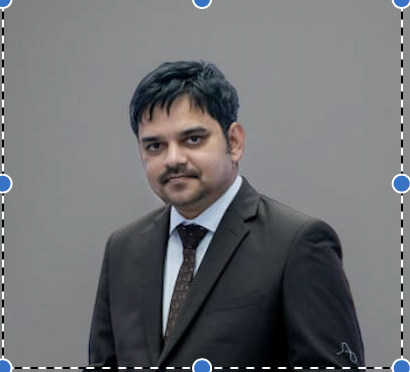
Prabhu Kumar Dasari
Prabhu Kumar Dasari
Senior AI Developer · Been building with this stuff since 2013

Last month my cousin asked me if he should "start learning AI." He works in banking, mid-30s, not a developer. I asked him what he did that morning. He said: checked WhatsApp, opened Instagram, ordered something on Swiggy, paid with UPI, drove to work using Google Maps.

He used AI at least a dozen times before 9am. He just didn't know it had a name.

That's what this series is about. Not the AI you need to learn, subscribe to, or prompt carefully. The AI that's already been running quietly inside the apps you open without thinking — making decisions about what you see, flagging things before you touch them, predicting where you're going before you say a word.

I've spent 13 years building AI systems for enterprises. I know how this machinery works from the inside. And I think most people deserve a plain explanation of what's actually happening in their pocket — without the hype, without the jargon, without being made to feel like they're behind.
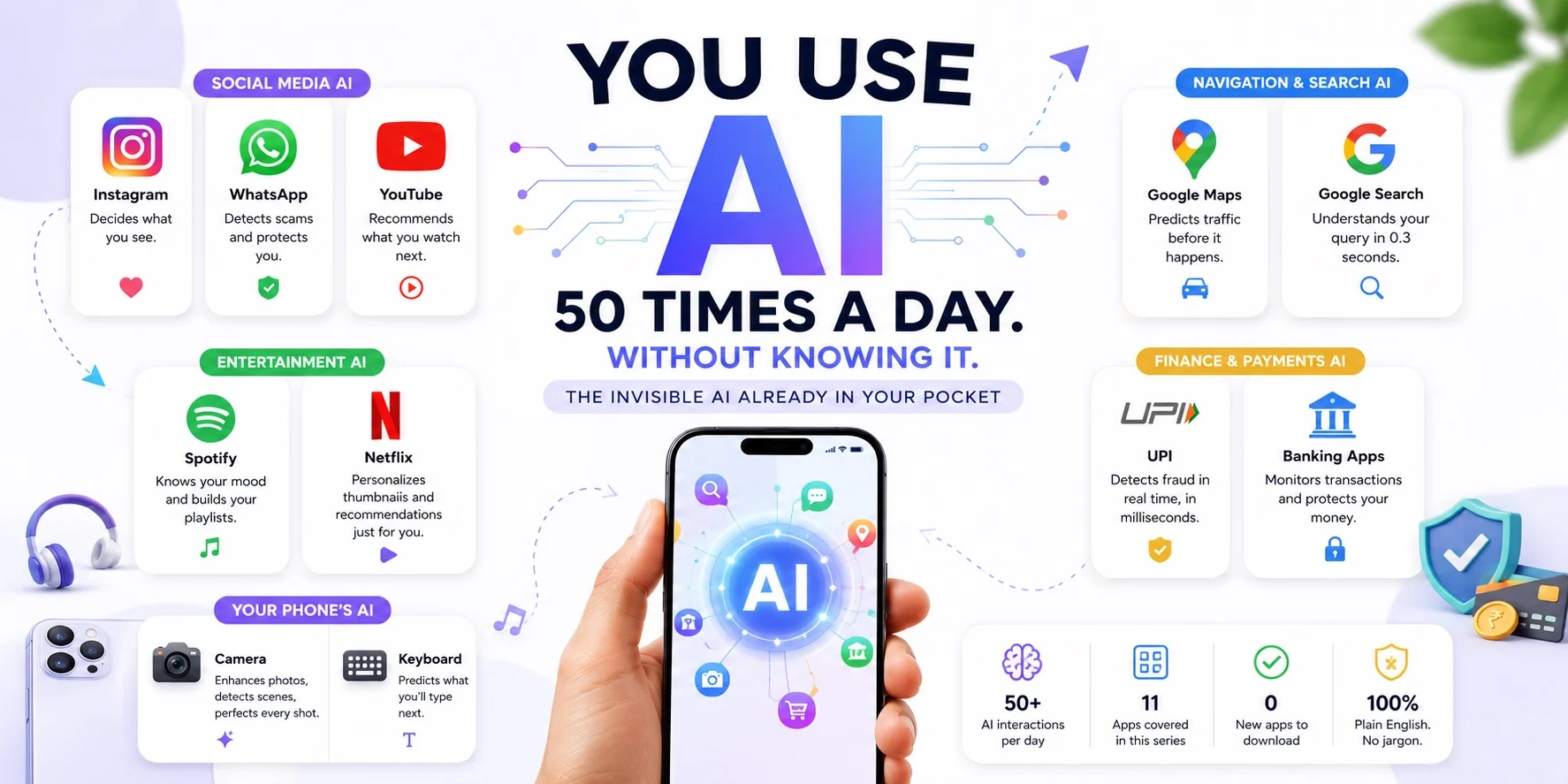
You use AI 50 times a day without knowing it — Invisible AI series infographic showing Instagram, WhatsApp, YouTube, Google Maps, Spotify, Netflix, UPI, Camera and Keyboard AI
The AI already running inside apps on your phone — 11 articles, no jargon
50+
AI interactions per dayAverage smartphone user, most without realising
11
Apps covered in this seriesWhatsApp to your bank. All already in your phone
0
New apps to downloadEvery AI explained here is already on your device
0%
Jargon toleranceIf I can't explain it to my cousin, I rewrite it
Why this matters

Understanding something doesn't require controlling it. But it helps.

I'm not going to tell you AI is dangerous or that you should be worried. I genuinely don't think that's a useful framing for most people. What I do think is that knowing how something works changes your relationship with it.

"When I understood why Instagram was showing me what it was showing me, I stopped doomscrolling by accident. I started scrolling on purpose."

When you know Google Maps is predicting traffic based on millions of GPS signals right now — not just historical data — you understand why it sometimes reroutes you at the last second. When you know Spotify's Discover Weekly is built partly from what music blogs are writing, not just your listening history, you understand why it occasionally recommends something weirdly niche and perfect.

That shift — from "the app did a thing" to "here's exactly why it did that thing" — is small. But it makes you a more intentional user. And in 2026, being intentional about what AI you're feeding and what you're getting back is quietly becoming one of the most useful skills around.

Chapter 1
📱 Social Media AI
The feeds you scroll, the stories you see, the ads that feel weirdly accurate — none of that is random. Here's the model making those calls.
📸
Instagram · Feed & Reels

How Instagram Decides What You See — And What It Buries

You follow 400 people. Instagram shows you maybe 15% of what they post. Here's exactly who decides which 15% — and why that one Reel you watched twice is now following you everywhere.

8 min read
💬
WhatsApp · Privacy + Safety

WhatsApp's AI Knows You're Being Scammed Before You Click

WhatsApp can't read your messages — they're encrypted end-to-end. So how does it still catch spam, flag dodgy links, and filter scam calls? The answer is more clever than most people realise.

6 min read
▶️
YouTube · Recommendations

How YouTube Decides What You Watch Next — And Why You Can't Stop

The two-stage AI engine, the satisfaction surveys, the rabbit hole mechanic, and why 70% of everything you watch on YouTube was recommended — not searched for.

8 min read Read article →
Chapter 2
🗺️ Navigation & Search
Before you type a word, before you pick a route — AI has already made a prediction. Here's how accurate those predictions actually are, and how they get made.
🗺️
Google Maps · Traffic AI

How Google Maps Predicts Traffic That Hasn't Happened Yet

It's not just historical data. Google Maps is processing millions of live GPS signals, incident reports, and weather data right now to predict your ETA more accurately than you'd believe.

7 min read Read article →
🔍
Google Search · How It Works

What Happens in the 0.3 Seconds After You Hit Search

RankBrain, MUM, spell correction, personalisation, featured snippets — five different AI systems fire before your results load. Here's what each one does.

7 min read Read article →
Chapter 3
🎵 Entertainment AI
The playlist that knew your Monday mood. The Netflix thumbnail that was different on your screen vs your partner's. This is not a coincidence.
🎧
Spotify · Recommendation Engine

How Spotify Knows What You Want to Hear Before You Do

Discover Weekly isn't magic. It's collaborative filtering + audio analysis + NLP on music blogs. Once you understand how it's built, it stops feeling creepy and starts feeling impressive.

7 min read Read article →
🍿
Netflix · Personalisation

How Netflix Decides What You Watch — And Changes the Thumbnail to Match

The same show has 20 different thumbnails. Netflix's AI shows you the one you're statistically most likely to click. Here's how it tests, learns, and serves them — per user, per country.

7 min read Read article →
Chapter 4
💰 Finance & Payments AI
The AI protecting your money is working faster than any human team could. India-specific: UPI has one of the most sophisticated real-time fraud detection systems in the world.
📱
UPI · NPCI Fraud Detection

How UPI Catches Fraud in Real Time — Without Slowing Down Your Payment

NPCI processes 14B+ UPI transactions a month. An AI risk engine screens every single one in under 100 milliseconds. Here's how it decides what's suspicious — without slowing you down.

7 min read Read article →
🏦
Banking · Fraud + Credit AI

How Your Bank's AI Watches Every Transaction You Make

Real-time transaction scoring, device fingerprinting, behavioural anomaly detection — and why your legitimate transaction sometimes gets blocked anyway.

7 min read Read article →
Chapter 5
📞 Your Phone's Built-in AI
Portrait mode, face unlock, next-word prediction — your phone is running AI models locally, right on the chip, without sending anything to the cloud. Here's what's actually in there.
📷
Camera · On-Device AI

The AI Firing Before You Press the Shutter

Scene detection, HDR merging, Night Mode, portrait depth estimation — your camera is running 5–6 neural networks simultaneously. Here's what each one does, and why the AI version of your photo isn't quite "real."

7 min read Read article →
⌨️
Keyboard · Prediction AI

The AI That Knows What You'll Type Before You Do

Autocorrect, next-word prediction, emoji suggestions, multilingual switching — Gboard is running a transformer model locally on your phone. And it's been doing this since 2019.

6 min read Read article →

One thing I want to be clear about upfront

I'm not writing these to make you paranoid about apps. I use Instagram, WhatsApp, Spotify, and UPI every day. I'm not planning to stop. And I don't think you should either based on what I'll explain here.

What I am saying is: these systems are optimised for their company's goals, not automatically for yours. Instagram's algorithm maximises time-on-app, not your mood afterward. Spotify's Discover Weekly maximises your engagement with Spotify, not necessarily your discovery of music you'd genuinely love long-term. Knowing that doesn't mean you stop using them — it means you use them with a slightly different set of eyes.

My cousin, after I explained the Instagram algorithm to him, didn't delete the app. He just started being more deliberate about what he paused on. That tiny shift — from passive receiver to informed user — is honestly the point of this whole series.