
What the Deal Actually Is
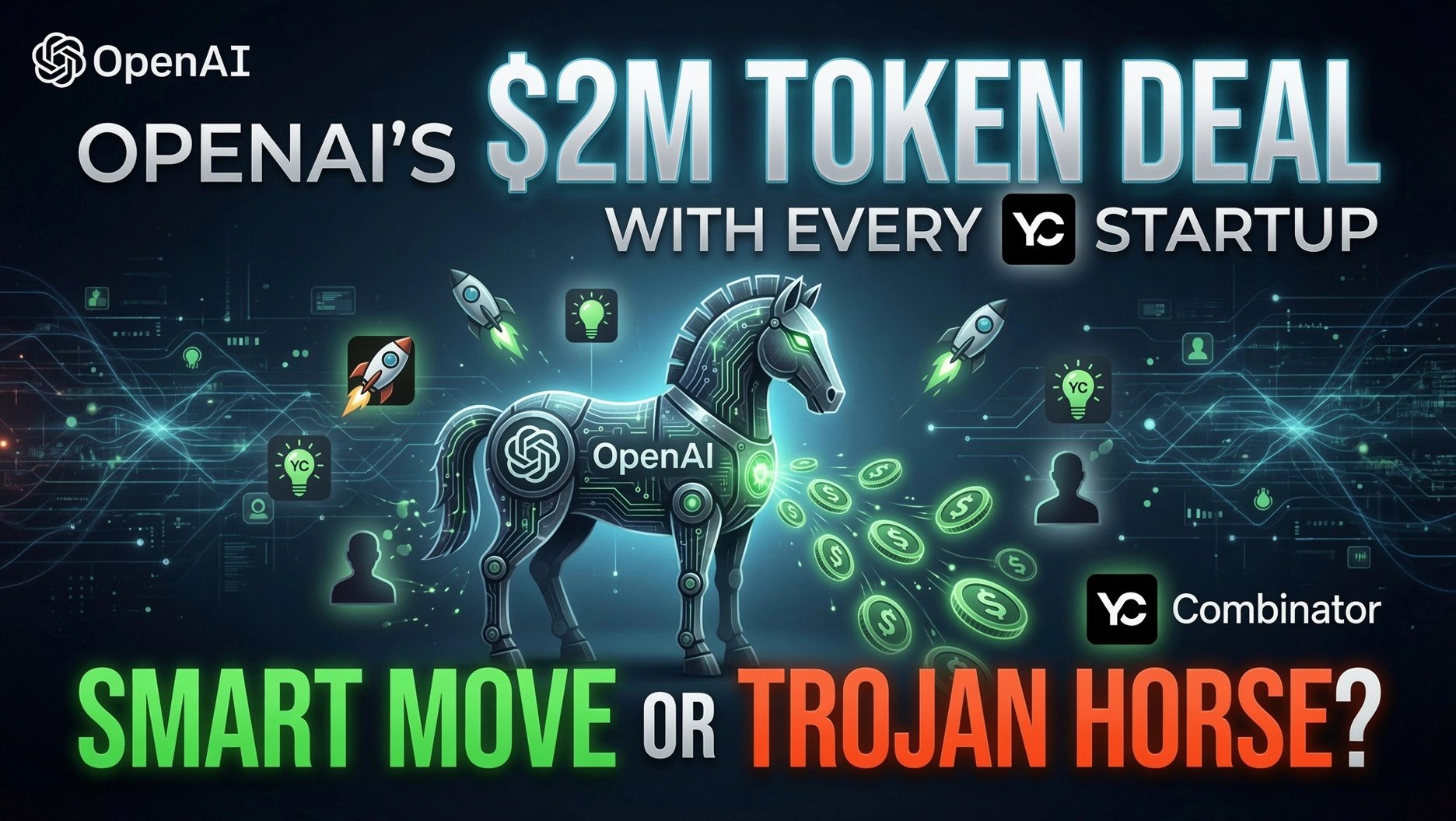
The structure is straightforward on its face: OpenAI offers $2 million worth of API tokens to each startup in the Y Combinator Spring and Summer 2026 batches. The tokens are usable across OpenAI's full API suite — GPT-4o, o3, Whisper, DALL·E, embeddings, fine-tuning, the works. In exchange, the startup grants OpenAI an equity position via an uncapped SAFE.
A SAFE — Simple Agreement for Future Equity — is a standard early-stage investment instrument. The startup receives investment now; the investor receives equity later, at the startup's next priced funding round. The "uncapped" part is what makes this deal different from a typical SAFE: there is no valuation ceiling agreed at signing. OpenAI's equity stake will price at whatever valuation the startup achieves at its Series A. If that's $10 million, OpenAI gets shares at $10 million. If it's $200 million, OpenAI gets shares at $200 million.
The Credits: $2 million in OpenAI API tokens, usable across all OpenAI services and the API.
The Equity: An uncapped SAFE — no valuation ceiling, converting to shares at the startup's next priced round (typically Series A).
Who Gets It: Every startup in the YC Spring 2026 and Summer 2026 cohorts — the offer is blanket, not selective.
The Source: Announced by Sam Altman directly at a YC event on May 20, 2026. YC Managing Director Jared Friedman confirmed the uncapped SAFE structure to TechCrunch.
Why OpenAI Did This — And It's Not Generosity
To understand the deal, you have to understand OpenAI's competitive position in mid-2026. The company is generating significant revenue, but the AI API market is no longer a monopoly. Anthropic's Claude API is rapidly gaining enterprise adoption. Google's Gemini models are deeply integrated into GCP. Meta's open-source Llama models let developers run inference for near-zero cost. Microsoft's Azure AI services bundle OpenAI models but also offer alternatives.
The early-stage startup market is particularly contested. YC companies in 2023 and 2024 defaulted heavily to OpenAI because it was the obvious choice. In 2025 and 2026, founders are making more deliberate infrastructure decisions — evaluating cost per token, model performance on their specific use case, and vendor risk before committing. OpenAI is watching its default status erode at exactly the moment the next cohort of high-growth companies is making foundational technology choices.
The $2M token offer solves two problems for OpenAI simultaneously. First, it removes the cost barrier that was causing founders to evaluate cheaper alternatives. If the credits are free, there's no reason to spend a week benchmarking Anthropic's API. Second, it creates structural dependency. Once a startup has built its product architecture around OpenAI's specific APIs — the function calling format, the embedding dimensions, the fine-tuning pipeline — switching to a different provider is a multi-week engineering project that no early-stage founder wants to do right before a fundraise.
The equity upside is the bonus: if even 5% of the YC startups accepting this deal become significant companies, OpenAI's financial return from the SAFE conversions will likely exceed the cost of the token credits many times over. YC has a documented track record of producing Stripe, Airbnb, Dropbox, Instacart, DoorDash, and Coinbase from its batches. OpenAI is betting that the next cohort contains at least a few of those.
The Case For Accepting — Why Founders Are Saying Yes
The Case Against — What the Fine Print Costs You
🎬 The Deal, Animated — Hidden Catches Nobody's Talking About
A fast-paced satirical breakdown of the real fine print: the uncapped SAFE jumpscare, the cap table dilution horror show, the vendor lock-in trap, and why your investor will eventually ask — "why is your supplier also on your cap table?" 51 seconds. Worth every one.
Comic-book style animated explainer · 51 sec · No fluff
The Ecosystem Play — What This Means Beyond the Individual Deal
Zoom out from the individual founder decision and the strategic picture becomes clearer. Y Combinator is the most influential pipeline of early-stage technology companies in the world. Its alumni companies represent trillions of dollars in combined market capitalisation. By inserting itself into every company in the current cohort — not just selected ones — OpenAI is making a systematic bet on the entire next generation of AI-native companies.
This is not unprecedented. Cloud providers have run similar programmes for years. AWS, Google Cloud, and Azure all offer substantial free credits to startups through accelerator partnerships. The difference is that those credits are grants, not equity instruments. OpenAI's version converts from credit to ownership — which changes the relationship from vendor to investor.
This deal is a direct competitive strike against Anthropic. Anthropic's Claude models are the primary alternative that technically sophisticated founders consider — and Anthropic's safety reputation appeals to startups building in regulated industries like healthcare, finance, and legal. By locking YC founders into OpenAI's ecosystem before they make deliberate infrastructure choices, OpenAI is specifically targeting the funnel that would otherwise produce Anthropic's best early customers. Expect Anthropic to respond with a counter-programme before the Summer batch Demo Day.
The broader implication is a shift in how AI infrastructure companies think about customer acquisition. Traditional SaaS growth relied on product quality, pricing, and sales motion. AI infrastructure growth increasingly looks like venture capital — take equity stakes in your best potential customers early, before they're large enough to negotiate. The $2M YC deal is the most visible version of a strategy that several AI companies are running more quietly.
What Founders Should Actually Do
If you're a YC founder looking at this offer, the question isn't whether to accept — it's how to accept responsibly. The credits are genuinely valuable. The uncapped SAFE is a real cost. Both things are true simultaneously.
The Bigger Picture — Compute Is Becoming Capital
The OpenAI-YC deal is the clearest signal yet that AI compute is transitioning from a commodity cost to a strategic asset — something to be invested, not just purchased. When a company can offer $2 billion in credits across a cohort and structure it as an equity investment rather than a marketing expense, the economics of the AI infrastructure market have fundamentally changed.
For the first time, the companies building AI infrastructure have the financial power to also become investors in the companies using that infrastructure. This creates alignment — OpenAI profits when its API customers succeed — but also concentration of power. An ecosystem where the AI model provider is also a significant equity holder in hundreds of AI-native companies is a different kind of market structure than the one that existed 18 months ago.
Whether this is good or bad for the startup ecosystem depends on who benefits at the exits. If OpenAI's SAFE equity converts at fair valuations and the company behaves like a passive financial investor, founders and co-investors are largely unaffected. If OpenAI uses its equity position and its role as infrastructure provider to influence product decisions, partnership choices, or acqui-hire conversations — that's a different story. The deal is too new to know which version will emerge. But the structure makes the second version possible in ways that a grant programme never would.
From a systems engineering standpoint, the most important question isn't the equity structure — it's the API dependency. AI APIs are not interchangeable in the way that, say, cloud storage buckets are. Prompt formats, context window handling, tool calling schemas, embedding dimensions, and fine-tuning data formats all differ meaningfully between providers. A startup that builds deeply on OpenAI's specific implementation over 12 months with $2M in credits will need 4–8 weeks of engineering time to migrate — during which time they cannot ship features. That migration cost is the real lock-in, and it has nothing to do with the SAFE.
Frequently Asked Questions
What is OpenAI's $2M token deal with YC startups? +
OpenAI offered every startup in the Y Combinator Spring and Summer 2026 cohorts $2 million worth of API credits in exchange for an equity stake structured as an uncapped SAFE. The credits are usable across all OpenAI services and the API, and the equity converts into shares at the startup's next priced funding round.
What is an uncapped SAFE and why does it matter here? +
An uncapped SAFE has no valuation ceiling at signing. OpenAI's equity converts at whatever valuation the startup achieves at Series A — meaning the better the startup does, the more expensive the $2M deal becomes in retrospect. A standard SAFE with a $10M cap would limit the dilution; an uncapped SAFE means the dilution is unknown until the next round closes.
Why did OpenAI offer this to every YC startup, not just selected ones? +
Blanket coverage ensures that the next generation of high-growth AI companies builds on OpenAI's infrastructure by default — locking them in before they make deliberate platform choices. It's also a direct competitive move against Anthropic, Google, and other API providers who were beginning to win mindshare with technically sophisticated founders. The cost of the credits is manageable; the equity upside from even a handful of breakout companies justifies the entire programme.
Should founders accept the deal? +
It depends on the startup's architecture and trajectory. Founders already building on OpenAI's API with no near-term reason to switch should likely accept — the credits reduce cash burn significantly. Founders who want model flexibility or are building in areas where Anthropic or Gemini perform better should weigh the lock-in risk carefully. Everyone should model the equity dilution at realistic Series A scenarios before signing.