How UPI Catches Fraud in Real Time — Without Slowing Down Your Payment
Last Diwali, my uncle got a WhatsApp message from someone pretending to be his bank, asking him to "verify" his UPI PIN on a fake page. He clicked the link, entered the PIN, and then — nothing happened. No money went anywhere. His bank's fraud detection had already flagged the session and frozen the transaction before he finished typing. He didn't know it at the time. He called me to say the bank website was "not working properly."
That near-miss was the UPI fraud detection system doing exactly what it was built to do: stop a transaction mid-stream, invisibly, without any friction to the real user. It's one of the most impressive pieces of financial AI infrastructure in the world — and almost nobody in India knows it exists.
In this article
How UPI Actually Works Under the Hood
Most people think of UPI as an app — Google Pay, PhonePe, Paytm. But UPI is the infrastructure beneath all of them, built and managed by NPCI (National Payments Corporation of India). The apps are just the interface; the rails are NPCI's.
When you tap "Pay" in Google Pay, here's what happens in sequence: Google Pay encrypts your request and sends it to its own server, which contacts your bank's UPI system, which routes the transaction request through NPCI's central switch, which contacts the recipient's bank, which confirms the VPA (Virtual Payment Address) and account, and then sends a settlement instruction back through the entire chain — all within a few seconds.
The fraud detection AI does not sit at one point in this chain. It operates at multiple layers simultaneously: inside the app (Google Pay, PhonePe each have their own fraud models), inside your bank's system, and at NPCI's central switch. Each layer can independently flag, delay, or block a transaction. The system is designed with this redundancy deliberately — if one layer misses something, another has a chance to catch it.
The 100-Millisecond Fraud Window
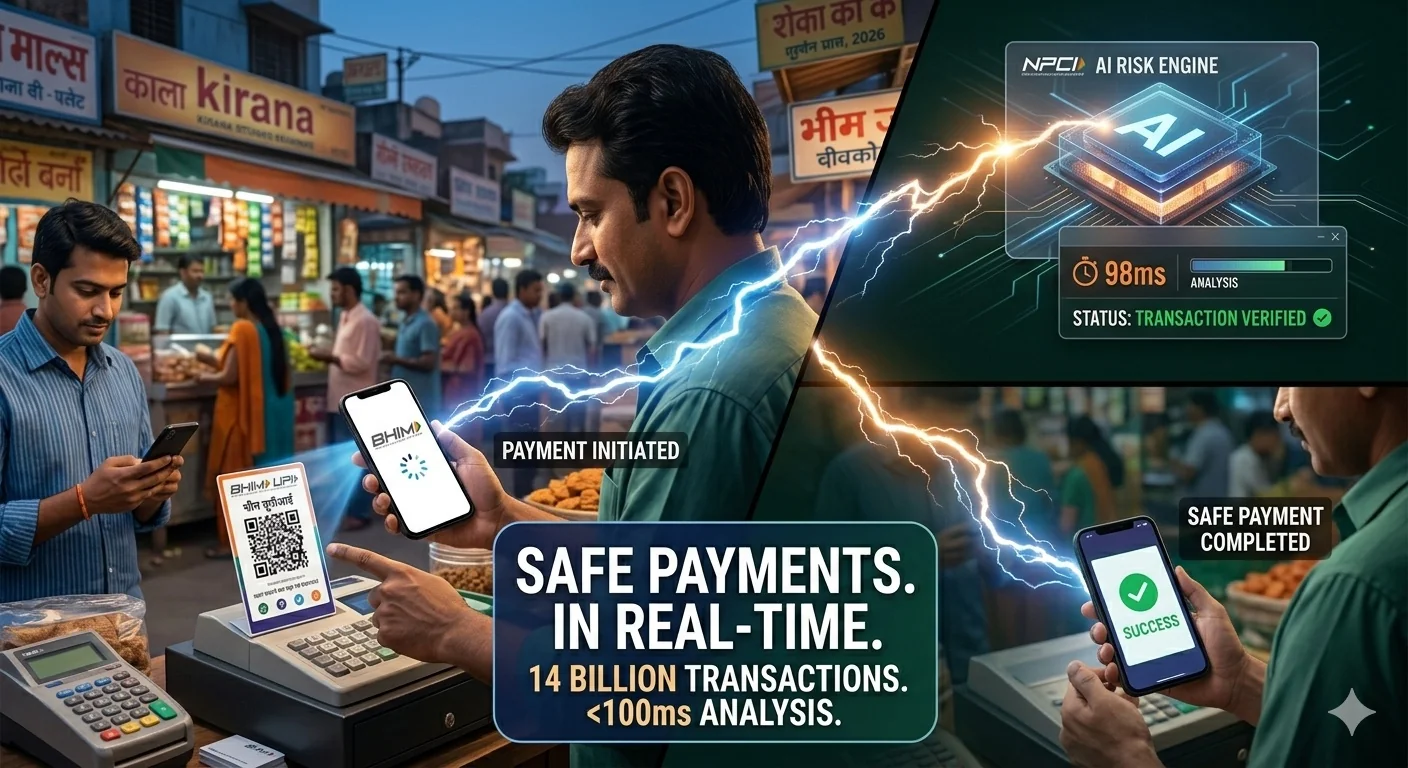
Here's the constraint that makes this engineering genuinely hard: UPI transactions are expected to complete in under 10 seconds for the user. The fraud detection layer gets a slice of that — roughly 50–150 milliseconds — to decide whether to allow, flag, or block the transaction.
In that window, the system has to:
Who is sending, to whom, what amount, from which device, at what time, from which location, using which app. This is assembled from multiple data stores simultaneously — your transaction history, the recipient's profile, device fingerprint databases.
A gradient boosting model (the most common architecture for financial fraud detection due to its speed and accuracy) scores this transaction against hundreds of features. The score is a probability: how likely is this transaction to be fraudulent?
Low risk: allow immediately. Medium risk: trigger additional verification (OTP challenge, "Are you sure?" screen). High risk: block the transaction and send alerts. The threshold between categories shifts dynamically based on transaction volume, time of day, and ongoing fraud pattern intelligence.
The fact that this entire pipeline completes in under 100ms — while querying live databases, running ML inference, and routing decisions across distributed systems — is a genuine engineering achievement. For reference, 100ms is roughly how long it takes a hummingbird to flap its wings once.
What the AI Is Looking at When You Pay
The fraud model uses signals from three categories: your behaviour, the transaction itself, and the recipient.
Your UPI payment history creates a behavioural baseline — typical amounts, typical recipients, typical times, typical locations. A transaction that deviates sharply from your baseline raises the risk score significantly. If you've never paid more than ₹5,000 via UPI and suddenly initiate a ₹50,000 transfer to an unknown VPA at 2am, that's a 3-sigma deviation — and it will be flagged even if every other signal looks clean.
Device fingerprint (hardware identifiers, OS version, app version), network characteristics (is this your usual cellular network or an unfamiliar WiFi?), and session behaviour (how fast did the user navigate through screens? Bots navigate differently from humans — too fast, no hesitation, perfect sequences). A session that looks automated is a strong red flag even if the account credentials are valid.
The VPA (phone number or UPI ID) you're paying to has its own risk score. How old is this VPA? Has it been involved in complaints or disputes? How many first-time payers is it receiving from (a hallmark of scam accounts)? Has it appeared in NPCI's fraud intelligence database? A new VPA receiving a large first payment from multiple unrelated users within 24 hours is a very specific fraud pattern the AI recognises immediately.
Fraudsters often test accounts with small transactions first (₹1, ₹10) to verify the account is active before the main fraud attempt. A pattern of small test transactions followed quickly by a large transfer is a known fraud sequence. The model also looks for amounts just below reporting thresholds — ₹49,900 instead of ₹50,000 — which is a classic money laundering signal.
High-value transactions at unusual hours (2–4am in India) have elevated baseline fraud rates. Transactions initiated within seconds of receiving a call or message (suggesting social engineering) get additional scrutiny. Festival periods — Diwali, Holi, Eid — see elevated fraud attempts and the models are pre-adjusted for these windows.
The 4 Scam Types UPI AI Catches Most
🎭 Social Engineering
- "KYC update required" fake calls
- Fake bank employee asking for PIN
- Lottery/prize money scams
- Caught via: session timing, recipient profile age, first-payment pattern
🔗 Screen Share Fraud
- Victim shares screen → attacker sees OTP
- Remote access apps active during UPI session
- Caught via: device state signals, session anomaly (two active sessions)
- App-layer detection (PhonePe, GPay warn if screen-share active)
📱 SIM Swap Fraud
- Attacker gets a new SIM with your number
- Uses it to receive OTPs for account takeover
- Caught via: SIM change recency flag, location mismatch, device change
- Banks now add cooling period after SIM changes
💸 Money Mule Accounts
- Legitimate-looking accounts used to funnel fraud proceeds
- High inflow from many sources, rapid outflow
- Caught via: velocity analysis, network graph of connected accounts
- NPCI shares mule account intelligence across banks
NPCI's Centralised Fraud Intelligence Layer
Here's what makes India's UPI fraud detection uniquely powerful compared to most payment systems globally: NPCI operates a centralised fraud intelligence layer that all banks and UPI apps share.
When a fraudulent account is identified — say, a VPA that ran a lottery scam — that information is shared across the entire network within minutes. The next person who tries to pay that VPA on any UPI app (Google Pay, PhonePe, Paytm, BHIM — doesn't matter) will see a fraud warning or the transaction will be blocked. No individual bank has to discover it on their own.
This network effect is enormously powerful. A scam that successfully defrauds one person in Mumbai generates intelligence that protects someone in Chennai who encounters the same scam account 10 minutes later. The system learns across the entire network, not just per bank.
India's UPI fraud rate is among the lowest in the world for a real-time payment network of this scale. That is not an accident. It's the result of a shared intelligence architecture that most countries' payment systems — including some far richer ones — don't have.
NPCI also runs a separate system specifically for "collect" fraud — the scam where you receive a payment request and are told to "approve" it to receive money. (You never receive money by approving a collect request. You only send it.) The collect fraud pattern is distinctive: high-value requests from unknown VPAs, often preceded by a social engineering call. NPCI's system flags these in real time with a specific "fraud risk" warning in the UPI interface.
When It Fails — And Why
The UPI fraud detection system is good. It is not perfect. Here's when it typically fails:
The victim is the one authorising the transaction. If you are fully in control of your own device and you deliberately send money to a scammer because you believe they're your bank or a lottery company — no fraud detection system can stop that. The technical signals look clean: it's your device, your behaviour, your UPI PIN. The fraud is in the social engineering, not in the technical execution. This is why "authorised push payment" fraud — where you're tricked into sending money yourself — is the hardest category to prevent.
New scam accounts. A brand-new VPA that has never been used before has no fraud history. The first few victims of a new scam account might not get warnings because the account hasn't been flagged yet. The system gets progressively better as more victims encounter the same account, but the first few transactions in a new scheme may get through.
Sophisticated behavioural mimicry. Well-organised fraud operations study the signals that trigger fraud alerts and train their operators to avoid them — using small test transactions, mimicking organic timing, using old established accounts as intermediate hops. Professional fraud rings are, in effect, trying to reverse-engineer the fraud model and stay below its detection threshold.
"Never share your UPI PIN and you'll be safe"
Your UPI PIN is one layer of protection. But screen-share fraud, SIM swap fraud, and remote access fraud can compromise your account without you ever explicitly sharing your PIN. And social engineering fraud works precisely because it convinces you to authorise transactions yourself — no PIN sharing required. The PIN protects against technical intrusion. It doesn't protect against being deceived.
The Honest Bit
UPI's fraud infrastructure is genuinely world-class. I don't say that lightly — India's payment network is being studied by central banks in multiple countries as a model for what real-time payment fraud detection can look like at scale.
But the data that powers this system is your complete payment history. NPCI knows who you pay, when, how much, from where, and on what device. Your bank knows this. Your UPI app knows this. This is not a secret — it's disclosed in the terms you agreed to. The trade-off is explicit: your behavioural data funds the fraud model that protects you.
Most people think that trade-off is worth it. I do too. But it's worth knowing it exists. "Free" and "secure" financial infrastructure has a data cost, and the data is more detailed than most people realise.
My uncle's phishing encounter ended well — the bank's fraud system flagged the session before any money moved. When I explained to him what had actually happened, his reaction was: "But I entered my PIN. Why didn't the money go?" The answer is that entering your PIN is not the last line of defence. The fraud system intervenes after authentication, at the transaction level.
He now treats any "action required" message from his bank with suspicion — he calls the bank's official number on the back of his card before doing anything. That habit, combined with the fraud detection system, is the actual defence. Technology covers what technology can cover. The rest is awareness.
The easiest thing you can do right now: make sure your bank has your current mobile number registered, and turn on transaction SMS alerts. The fraud system will catch most things. The SMS will catch the rest — because you'll see the transaction before the fraudster can act on it.
Next in the series: Bank AI Fraud Detection — how traditional banks (HDFC, SBI, ICICI) layer their own AI on top of UPI, and what happens in the fraud detection chain when you use a credit card.