
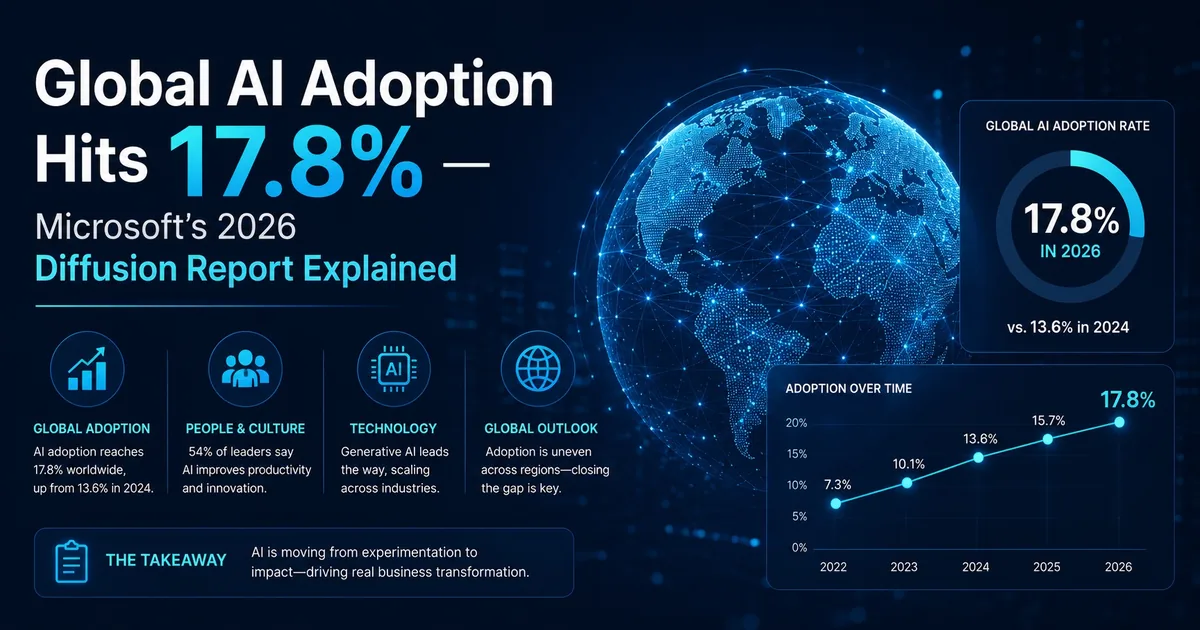
Key Numbers at a Glance
Breaking Down What the Numbers Mean
1.5 percentage points in a single quarter
Moving from 16.3% to 17.8% in three months translates to roughly 60 to 70 million additional people actively using AI for work. That pace has not slowed despite AI being several years into mainstream availability — which suggests adoption is still in an acceleration phase rather than plateauing. The question is whether this rate can be sustained as AI pushes into more complex and regulated industries.
The UAE is in a completely separate category
A 70.1% adoption rate among the working-age population is not incrementally better than other countries — it is qualitatively different. For context, the global average is 17.8% and even the United States sits at 31.3%. The UAE's number reflects deliberate national AI strategy, significant government investment in digital infrastructure, a highly educated and internationally connected workforce, and an economic model that actively incentivises technology adoption.
The United States is underperforming relative to its position
Moving from 24th to 21st globally at 31.3% is progress, but it is not a story of American AI leadership in practice — it is a story of the US catching up to smaller economies that have moved faster. The gap between where the US leads (AI investment, AI company formation, AI model development) and where it ranks in actual workforce adoption is one of the more interesting tensions in the data.
South Korea, Thailand, and Japan recorded the largest movement this quarter, driven by rapidly improving AI capabilities in Asian languages. As frontier models become genuinely effective in non-English languages, adoption across Asia — including India — is expected to accelerate significantly through the remainder of 2026.
The Developer Employment Surprise
Perhaps the most counterintuitive finding: despite AI coding tools becoming dramatically more capable over the past 18 months, US software developer employment reached a record high of 2.2 million in 2025, up 8.5% year-over-year. Early Q1 2026 data shows this trend continuing, with March 2026 developer employment running approximately 4% above March 2025 levels.
The explanation sits in basic economics. When AI makes individual developers more productive, it reduces the cost of building software. When the cost of building software falls, demand for software increases — organisations that previously could not afford custom systems now can. GitHub push activity rising 78% year-over-year is the clearest signal that developers are building more, not being replaced.
- AI complements developer productivity — handles repetitive code generation, freeing developers for architecture and problem-solving
- Demand for software is elastic — lower costs unlock entirely new categories of software investment
- Skills gap is widening — developers who use AI tools well are substantially more valuable than those who do not
What This Means for India
India was not highlighted in this quarter's headline findings, but several underlying trends are directly relevant. The acceleration driven by improved multilingual capabilities will significantly benefit India's vast Hindi, Tamil, Telugu, Bengali and regional language populations who have been underserved by English-first AI tools. India's large English-speaking developer base is already well-positioned to benefit from AI coding tools, and the Indian government's AI Mission creates a policy environment that should support faster adoption through 2026 and 2027.
The developer employment data is the finding I keep returning to. Every week brings another headline claiming AI will eliminate developer jobs, and every quarter the actual employment data says something more nuanced and more optimistic. What is genuinely happening is role expansion, not replacement. Developers who embrace AI tools are shipping faster, building more complex systems, and becoming significantly more valuable. For anyone in tech in India, this report's message is unambiguous: the tools are there, the demand is rising, and the opportunity is largest for those who adapt first.