
What Meta Is Actually Building
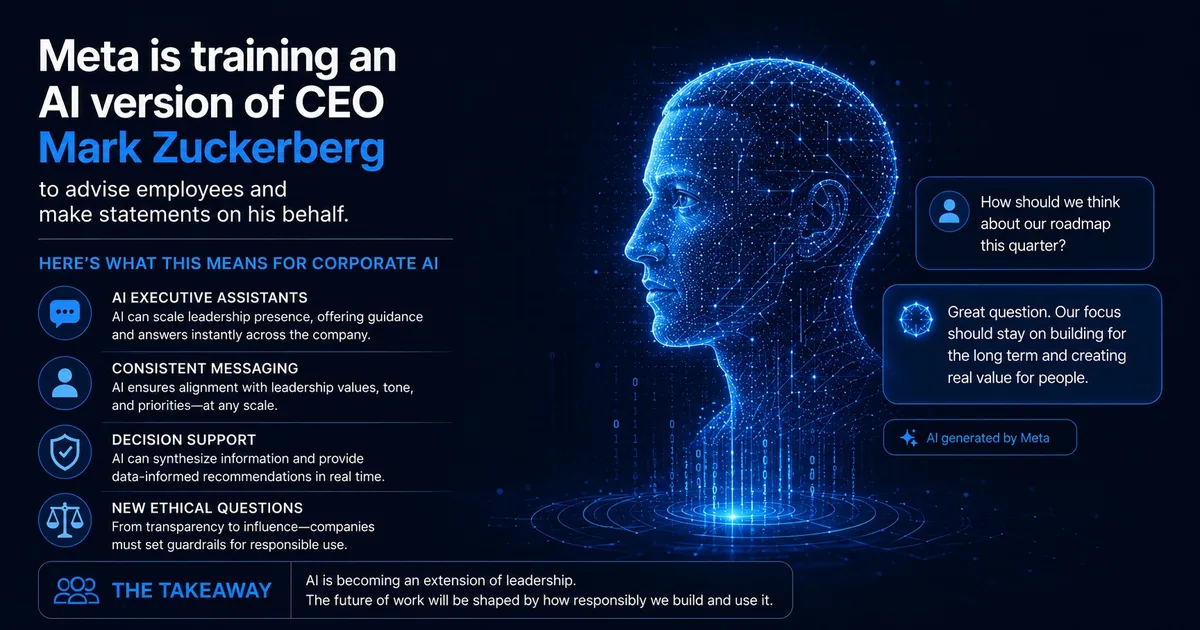
According to the Financial Times report, Meta's AI Zuckerberg model is designed to serve three core functions: providing strategic advice to employees, making public-facing statements, and representing Zuckerberg's decision-making philosophy when he cannot be physically present. The model is being trained on his past communications, interviews, recorded strategy sessions, and documented company direction.
The underlying logic is straightforward. Zuckerberg cannot attend every meeting, answer every employee question, or personally weigh in on every decision across a company with tens of thousands of employees. An AI trained on how he thinks is meant to offer consistent strategic guidance at scale — essentially making his judgment available across the organisation simultaneously.
This is not a general-purpose chatbot or customer-facing product. It is an internal executive AI — built specifically to replicate the thinking and communication style of a named individual CEO. That makes it categorically different from anything deployed at this scale before.
Why This Is Significant
The first major CEO AI model
There have been AI assistants, executive summarisation tools, and AI-generated company updates before. But an AI specifically designed to represent a named CEO's decision-making — and potentially make statements on their behalf — is genuinely new territory. Meta is setting a precedent here, whether intentionally or not, and other major companies will be watching closely.
The accountability question
If an AI trained on Zuckerberg's thinking gives an employee incorrect or harmful advice, who is responsible — the AI, the company, or Zuckerberg personally? If the model makes a public statement that turns out to be factually wrong or reputationally damaging, what is the legal exposure? These are not hypothetical edge cases — they are central questions that Meta's legal and ethics teams must be working through right now, and existing frameworks do not provide clean answers.
The signal for enterprise AI broadly
If this experiment works at Meta, the template becomes obvious: Amazon builds a Bezos-trained strategic AI, Nvidia builds a Jensen Huang AI for internal R&D decisions. Every major organisation eventually has an AI version of its leadership, available to employees around the clock. Whether that future feels efficient or deeply uncomfortable depends significantly on how much you trust the accuracy of the model itself.
The Risks That Need Attention
- Perceived authority vs actual reliability — Employees may treat the AI Zuckerberg's guidance as more authoritative than it deserves, precisely because it sounds like someone they know and trust.
- Identity and consent complexity — What does it mean for a living person to have an AI version of themselves operating independently? What happens when the AI says something the real person disagrees with?
- Chilling effect on internal dissent — If employees can get "Zuckerberg's view" on any question instantly, contrarian or critical thinking may get quietly suppressed.
- Employee data privacy — Employees interacting with the AI model may not fully understand what data from those interactions is retained and how it is used.
What This Means for the AI Industry
Meta's move is part of a broader trend of AI moving from task automation to role simulation. The current generation of AI tools automate specific tasks — writing emails, summarising documents, generating code. The next wave attempts to simulate entire human roles and decision-making styles. That is a fundamentally different kind of AI deployment, with fundamentally different implications for trust, accountability, and workplace dynamics.
I find this genuinely fascinating and genuinely concerning in equal measure. The technical challenge of building a model that accurately represents how a specific person thinks is impressive. But the moment employees start deferring to the AI Zuckerberg without knowing whether a decision came from the real person or the model, you have a trust problem that no amount of engineering can fix. The public statement angle concerns me most — an AI making statements attributed to a CEO creates liability that existing legal frameworks are simply not designed to handle yet.