Neural-Adaptive XR: The Next Generation of Immersive Tech That Doesn't Exist Yet
I've been building XR experiences for 13 years. I've watched AR go from image targets on printed markers to spatial computing on glasses. I've seen VR move from tethered PC headsets to fully standalone devices powerful enough to run enterprise simulations. I've shipped projects at GITEX Dubai and ADIPEC Abu Dhabi. And yet — when I honestly ask myself what would make the next generation of XR feel truly transformative rather than just iterative — the answer keeps coming back to one concept: the headset that knows what's happening inside your head, not just in front of it.
I recently explored this question through Perplexity AI and the research it surfaced confirmed what I've suspected from building these systems: the most exciting next-gen XR concept isn't better displays, lighter headsets, or more accurate hand tracking. It's neural-adaptive XR — immersive environments that continuously read your nervous system signals and dynamically reshape everything around you in response.
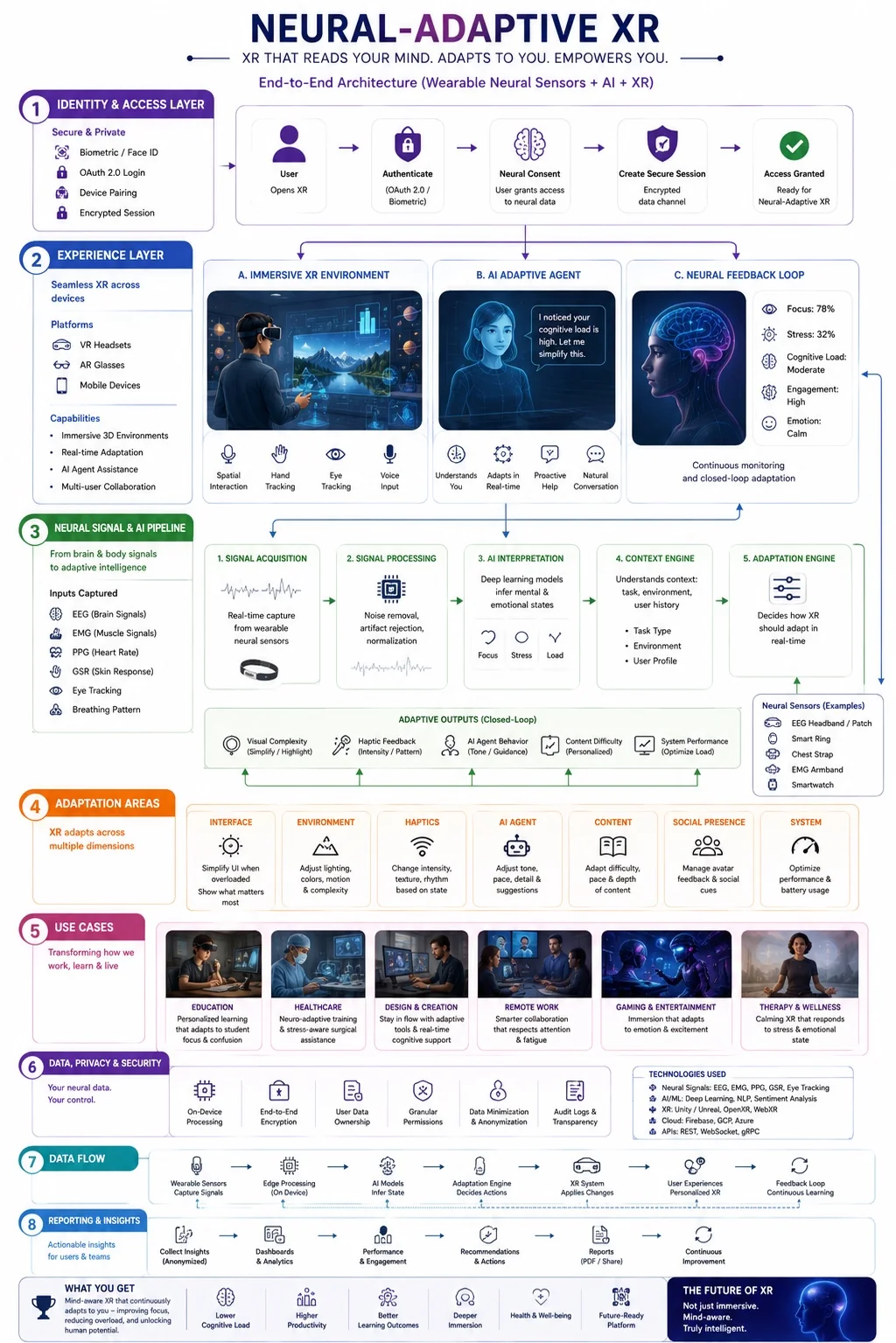
What is Neural-Adaptive XR?
The core idea is a system that does three things simultaneously and in real time:
🧠 Read Your Nervous System
Non-invasive sensors — EEG headbands, EMG patches, skin-integrated electrodes, or glasses-embedded sensors — capture your brainwave patterns, muscle signals, and skin electrical potential continuously as you use the device.
🤖 Infer Your State
On-device ML models decode those signals in real time — determining whether you're focused, stressed, confused, fatigued, or cognitively overloaded. Not from what you say or where you look. From what your nervous system is actually doing.
🎮 Reshape the Experience
The XR environment adapts automatically: haptics adjust in rhythm and intensity, visual complexity simplifies or enriches, and the AI agent changes how it speaks to you — slower, simpler, more proactive — based on your real cognitive state.
🔄 Close the Loop
This isn't a one-time calibration. The system runs as a continuous closed loop — sensing, inferring, adapting, sensing again — throughout the entire session, responding to micro-changes in your state as tasks shift in difficulty.
The biological signals it would read continuously:
XR That Adapts to You
Imagine wearing lightweight XR glasses during a complex task. As your cognitive load increases, the interface automatically simplifies itself — before you consciously realise you need it to.
🔄 When Cognitive Overload Is Detected
Distracting UI elements fade away · Important information gets highlighted · The AI assistant speaks more slowly and clearly · Haptic feedback becomes calmer and more focused
🚀 When Peak Focus & Confidence Are Detected
Immersion deepens · Advanced controls unlock · The AI agent steps back and gives you space · More complex interactions and information become available
Instead of humans constantly adapting to software — the software adapts to the human. That shift is the core of what makes neural-adaptive XR a genuinely new category of computing.
This is fundamentally different from anything shipping in 2026. Today's XR systems adapt to where you look (eye tracking), what you do (hand pose, voice commands), and where you are (positional tracking). Neural-adaptive XR would adapt to what you feel and how your brain is actually performing. That is a different category of personalisation entirely.
The key distinction: Current XR reads your body's outputs — gestures, gaze, voice. Neural-adaptive XR would read your nervous system's internal state. It's the difference between watching someone's hands and understanding what's happening in their mind.
My Take After 13 Years in XR
When I built the VR Learning Studio — a multimodal AI training platform that used Azure Speech, NLP emotion detection (ParallelDots), and Dialogflow together to evaluate learner performance — I kept hitting the same wall. The system could detect what the trainee said and even some emotional tone in their voice. But it had no idea whether they were actually cognitively overloaded, whether they'd mentally checked out, or whether they were in a state of peak focus. We were inferring internal state from external signals.
Neural-adaptive XR would close that gap entirely. In a VR training scenario — a gas valve operation, a surgical procedure, a high-stakes negotiation simulation — the system would know in real time whether you are performing at your cognitive best or approaching overload. It could slow the scenario down before you make an error. It could trigger the AI instructor to intervene before you disengage. That's a qualitatively different level of personalised learning.
I've seen enough enterprise XR deployments to know what the real bottleneck is: not the graphics, not the interaction model, but the inability to respond to the human inside the headset as a biological system with fluctuating attention and variable cognitive states. Neural-adaptive XR is the concept that solves that.
What's Not Available Yet in 2026
The research is clear on exactly where the gaps are, and they're significant:
❌ Reliable Low-Latency Neural-Haptic Closed Loops
Small-scale lab systems exist that tweak vibration patterns based on EEG-decoded user preferences. But they are far from stable, low-latency, or consumer-grade. No major headset ships a tight real-time brain-to-haptics pipeline that preserves immersion — current systems introduce jitter and delay that breaks presence.
❌ Wearable Neural Interfaces That Feel Like Normal Glasses
"Electronic skin" XR interfaces — soft, flexible patches that read neural and muscle signals — are being prototyped in labs, but they remain lab-only in 2026. No product exists that combines neural sensing with the form factor of everyday glasses, earbuds, or rings at consumer quality.
❌ Neural Feedback Integrated Into XR Operating Systems
Android XR, Meta OS, and visionOS can use AI assistants, but none integrate continuous neural feedback into the operating system itself to globally reshape UI, compute load, and social presence. The OS has no concept of your cognitive state.
❌ Consumer-Grade EEG Accuracy for Real-Time Inference
EEG signal quality degrades with movement, sweat, and electrode contact variation — all extremely common in active XR use. Lab-grade EEG requires controlled conditions. Getting the signal quality needed for reliable real-time cognitive inference in a moving, sweating headset user remains an unsolved hardware problem.
Why This Would Be Genuinely Next-Gen
If built well — and that's a significant if — neural-adaptive XR would change immersive technology in three profound ways:
Cognitive Load Management in High-Stakes Training
In the enterprise XR scenarios I've built — gas safety, tanker inspection, surgical simulation — the highest-value moments are precisely when the trainee is most cognitively stressed. A system that detects rising cognitive overload and automatically simplifies the UI, slows the scenario, or brings in the AI instructor proactively would prevent the cascade of errors that happens when overwhelmed trainees push through. The training outcome improves not because the content changed, but because the delivery adapted to the person receiving it.
Personalised Immersion at Scale
Users fatigue differently. Some reach sensory overload quickly; others need denser, more complex environments to stay engaged. A neural-adaptive system could tune visual complexity, audio intensity, and interaction pace individually — not from a one-time profile setup, but continuously and automatically. Enterprise XR deployments currently require content creators to build multiple difficulty tiers and hope the trainee self-selects correctly. Neural-adaptive XR makes that automatic.
XR as a Mind-Aware Companion
The most exciting implication is the AI agent layer. An XR-LLM agent that can detect — not guess — when you are stuck, confused, or disengaged is categorically more useful than one that can only respond to what you say or where you look. It could restructure the task, suggest a different approach, or simply offer a moment of reduced stimulation before you consciously realise you need one. That is the difference between a responsive tool and a genuinely intelligent companion.
Real-World Applications
The use cases aren't speculative in principle — they're direct extensions of technology that already exists separately. The challenge is integration, not imagination.
Learning environments could adapt difficulty, pacing, and visual complexity based on real-time student attention and stress — not test scores after the fact.
Surgeons could receive simplified contextual interfaces during high-pressure procedures. Therapy XR could create emotionally responsive, calming environments that adapt to patient state.
Games could dynamically respond to fear, excitement, confidence, or fatigue to create deeply personalised experiences that feel genuinely alive and responsive.
Virtual meetings could adjust communication flow and presentation complexity based on live audience engagement — not guessed from camera feeds, but measured from biometrics.
AI copilots in XR workspaces could proactively assist before frustration or overload occurs — especially relevant to the high-stakes industrial simulations I've built.
Therapeutic XR environments could detect rising anxiety and automatically activate grounding visuals, ambient audio shifts, and breathing guidance before the user consciously notices distress.
The Closest Things We Have Today
We're not starting from zero. Several existing technologies point toward neural-adaptive XR even if none of them fully realise it:
- Eye tracking (Apple Vision Pro, Meta Quest Pro) — Adapting foveated rendering to gaze is the earliest version of "the device responds to your biology." It's a start, but gaze tells you where attention is directed — not whether attention is actually present.
- Muse headband + meditation apps — Consumer EEG that adapts audio feedback to your brainwave state in real time. Narrow use case, but the hardware principle is proven at consumer price points.
- Neurosity Crown — Developer-focused EEG headset with SDK for building attention-aware applications. Not XR-native, but the closest existing developer tool to neural-adaptive input.
- Convai AI conversational agents in XR — (I used Convai in my ADIPEC tanker inspection project.) These agents can respond to what you say and adapt dialogue accordingly. Add neural state as an additional input signal and you're approaching true neural-adaptive AI guidance.
- Biometric-adaptive games — Horror games that use heart rate monitors to adjust scare intensity have existed since the early 2010s. A crude but functional proof of concept that biometric-adaptive XR is achievable in principle.
When Might This Arrive?
My honest developer's estimate: a full consumer-grade neural-adaptive XR system is 8–12 years away. The individual components — EEG sensing, on-device ML, haptic hardware, AI agents — are all advancing. The integration challenge is what makes this hard. You need all of them working together, reliably, in a device people will actually wear for hours.
What I expect to see sooner, in the 3–5 year window:
- Attention-aware XR — headsets that detect when your focus drops (from gaze patterns and possibly basic EEG) and adjust content pacing or trigger notifications accordingly
- Stress-adaptive haptics in enterprise training — closed-loop systems that detect elevated physiological stress and adjust scenario difficulty in industrial VR simulations
- Neural input as an accessibility feature — EMG-based gesture control (already in development at Meta and Apple) as an alternative input modality, before full cognitive-state adaptation
The path from today's XR to neural-adaptive XR is a series of incremental steps, each one more capable than the last. The destination — an immersive environment that genuinely feels like it understands not just your body but your mind — is the most compelling thing I can imagine building. And the fact that it doesn't exist yet makes it the most interesting problem in this space.
Bottom line: Neural-adaptive XR is the concept that would make the jump from "impressive technology" to "indistinguishable from intelligence." We have the research. We have the component parts in early forms. We don't yet have the integration. That gap is where the next decade of XR innovation will be won.
Thinking about the future of XR for your organisation?
I've built enterprise XR across oil & gas, healthcare, government, and corporate training sectors. If you're exploring what's possible — whether a proof of concept today or planning for what's coming next — I'm happy to talk through it.
Get in touch → or explore the full XR portfolio.