What Happens in the 0.3 Seconds After You Hit Search
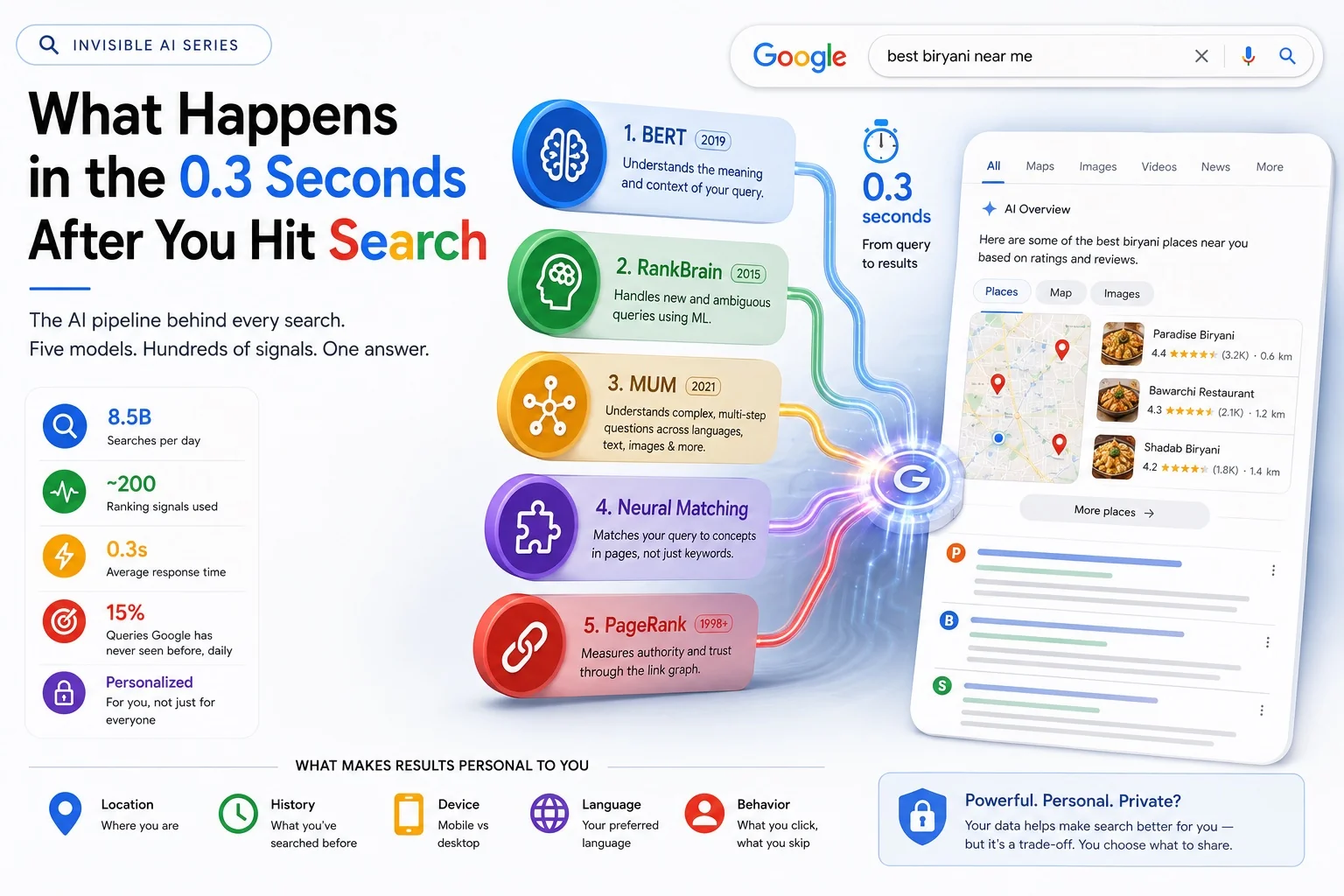
You type "best biryani near me" and press Enter. In 0.3 seconds — less time than it takes you to blink — Google has corrected any typos, understood what you actually meant, checked hundreds of ranking signals, personalised the results to your location and history, decided whether to show a map, a featured snippet, or a direct answer, and rendered a page. At least five different AI systems ran to make that happen.
Most people think of Google Search as one algorithm. It isn't. It's an assembly line of models, each doing a specialised job, passing their output to the next in sequence. Understanding what each one does explains a lot — why your results differ from your colleague's for the same query, why featured snippets appear and disappear, and why SEO works the way it does in 2026.
In this article
Stage 1: Understanding What You Actually Meant
Before Google can rank anything, it has to understand your query. This sounds simple — you typed words — but it's genuinely hard. "Jaguar" could mean the car, the animal, or the football club. "Apple store near me" is a location query, not a shopping query. "Is it safe to mix bleach and vinegar" is an immediate safety concern, not a chemistry question.
Google calls this query understanding, and it happens before any ranking starts. The system tries to answer three questions: What is the intent behind this query (informational, transactional, navigational, local)? What entities is the user asking about? And is there something wrong with how the query was phrased — a typo, an ambiguous term, a query that would be better served by a slightly different interpretation?
The spell correction alone is a machine learning model in its own right. When you type "restaurent near me," Google doesn't just pattern-match against a dictionary. It considers the most probable word given the characters you typed, weighted by how common that correction is across millions of other users who made similar mistakes. It also sometimes shows results for the corrected query while noting "Showing results for 'restaurant near me' — did you mean 'restaurent'?" — that courtesy is automated, and it's serving the corrected version because the model is confident enough.
The Five AI Models Running in Sequence
Here are the main models that have been publicly documented by Google, in rough order of when they fire in the pipeline:
Bidirectional Encoder Representations from Transformers. A transformer-based model that reads your query in context — understanding that the word "to" in "English learners to understand" means something different than "to" in "how to fly to Paris." BERT helped Google handle prepositions, conjunctions, and nuance that older keyword-matching systems missed entirely.
A machine learning system specifically built for queries Google has never seen before — about 15% of daily searches. RankBrain interprets unfamiliar queries by converting them into vectors (mathematical representations) and finding content with similar vectors, even if the exact words don't match. It's why searching for "what's that movie where the guy is lost in space alone" returns The Martian. It understands meaning, not just keywords.
1,000× more powerful than BERT, trained on 75 languages simultaneously, able to understand text, images, and (in later versions) video. MUM handles complex, multi-part queries — "I've hiked Mount Fuji, what should I prepare differently for hiking the Rockies?" Before MUM, you'd need to break this into multiple searches. MUM understands the comparison, the implicit context (altitude, climate, gear differences), and can surface content that never uses your exact keywords.
Connects the concepts in your query to concepts in web pages, even when the wording is completely different. If you search for "my nose won't stop running," Neural Matching knows this is about a cold, not about a physical competition. It matches query intent to document concepts rather than surface-level text overlap — which is why keyword stuffing stopped working years ago.
People assume PageRank is dead. It isn't. The original algorithm — which ranks pages by the number and quality of links pointing to them — is still a fundamental signal. What's changed is that it's now one input among 200+, not the dominant signal. A page with 10 excellent backlinks from authoritative sources can still outrank a page with 1,000 low-quality links. The link graph still matters; it's just no longer the whole story.
What Actually Determines Your Position
Google uses around 200 ranking signals, and has confirmed some while keeping others private. Here are the ones that are both confirmed and well-understood:
Does this page actually answer the query? This is assessed not by keyword count but by topical depth and semantic coverage. A page about "coffee brewing methods" that covers pour-over, French press, espresso, and cold brew in depth will score higher for a broad coffee query than a page that repeats "best coffee brewing method" 40 times.
Core Web Vitals: how fast does the page load (LCP), how much does it shift around while loading (CLS), and how quickly does it respond to input (FID/INP). Google made these official ranking signals because a fast, stable page is a better experience — and user experience correlates with satisfaction, which they can measure through browser data.
For "Your Money or Your Life" queries — health, finance, legal, safety — Google's Quality Raters evaluate pages on these four dimensions. A medical article written by a named doctor on a hospital website scores higher than an anonymous article on a content farm, even if the text is similar. This is especially important in India, where health misinformation spreads rapidly.
Links from reputable, topically relevant sites carry real weight. A link from a leading medical journal to a health article is worth more than 50 links from generic directories. Google's Penguin algorithm specifically demotes sites trying to game this with purchased or low-quality link schemes.
Recent content gets a temporary freshness boost for time-sensitive queries ("latest iPhone review," "election results today"). For evergreen queries ("how to boil an egg"), freshness matters much less. The model detects query type and adjusts accordingly.
"If I use the keyword 10 times, I'll rank higher"
Keyword density as a ranking factor effectively died with the Hummingbird update in 2013. What matters is semantic depth: does this page cover the topic fully, answer related questions, and demonstrate expertise? A page that mentions "diabetes" once but covers symptoms, causes, risk factors, management, and medication thoroughly will outrank a page that says "diabetes treatment for diabetes patients with diabetes" repeatedly.
Why Your Results Aren't the Same as Mine
Here's something that surprises people: if you and I both search for "Python tutorial" right now, we will likely see different results. Not dramatically different — the first few results will probably overlap — but the order and mix will vary based on:
Location. Google knows where you are (unless you've blocked it) and prioritises content relevant to your region. An Indian user searching "best bank account" will see results featuring Indian banks. A UK user sees UK results. This isn't just for "near me" queries — it's baked into most results.
Search history. If you've been searching for beginner Python content, Google weights beginner tutorials higher. If your history shows you're a developer, it might weight advanced documentation higher. This personalisation is subtle — it doesn't override relevance, it nudges it.
Device type. Mobile search results often differ from desktop, partly because Google uses a mobile-first index (mobile versions of pages are the "official" version for ranking purposes) and partly because mobile queries tend to be shorter and more intent-driven.
Logged-in vs incognito. In an incognito window, you lose the personalisation layer. The results you see are closer to "generic" results for your location and language. This is a useful way to see what Google actually thinks about a topic without your history filtering it.
I searched "should I invest in crypto" logged in and in incognito on the same day. The first result was different. Not opposite — but different enough that the framing changed. It's a reminder that what Google shows you is partly a product of what Google knows about you.
How Featured Snippets Get Picked
Featured snippets — the box at the top of results that directly answers a question without you having to click — are generated by a system that reads the top-ranking pages and extracts the passage that most directly answers the query.
A few things about snippets that aren't widely understood:
First, you don't have to be in position 1 to get a featured snippet. Google pulls the snippet from whichever page best answers the specific question, even if that page ranks 4th or 5th for the broader query. This is why content that directly answers a specific question ("What is X?" with a clear, one-paragraph definition) can earn a snippet even on a relatively new site.
Second, snippets are not permanent. Google continuously re-evaluates them. If a better answer appears, the snippet changes. If a snippet starts generating many negative feedback signals (people immediately searching for more because the snippet was incomplete or wrong), it gets demoted.
Third, since the 2023-2024 rollout of AI Overviews (formerly Search Generative Experience), there's now a generative layer at the top of many results. This layer uses a large language model to synthesise an answer from multiple sources — it's not pulling from one page but generating a response based on many. This has changed what kinds of queries get snippets vs AI-generated summaries.
How Google Search Behaves Differently in India
India is one of Google's most complex search markets — and the algorithm handles it differently in ways that matter.
Language switching. Indian users frequently mix languages — searching in Hinglish (Hindi + English mix), using English queries but preferring results in regional languages, or switching mid-session. Google's systems have had to learn to handle this gracefully. If you search "biryani recipe" in Hyderabad, you might see results in both English and Telugu, depending on your history.
Voice search patterns. Voice search usage in India is disproportionately high, particularly in Tier-2 and Tier-3 cities where typing in a non-primary language is harder. Voice queries tend to be longer and more conversational — "where can I get a good thali nearby that's open now" rather than "thali restaurant open." Google's voice search models in Indian languages have been specifically retrained on local speech patterns.
Local content surfacing. Google has made explicit efforts to surface more Indian-language web content through its Project Navlekha initiative, which helped small publishers create web-indexed content in regional languages. This means the index for regional-language queries has grown substantially — but the quality signals are still catching up.
YMYL in Indian context. Health misinformation is a particular concern in India, and Google's E-E-A-T signals specifically try to down-rank content that makes medical claims without authoritative backing. In practice, this means that a government health portal's content will rank much higher for drug interaction queries than an anonymous blog, even if the blog post is better-written.
The Honest Bit
There is a tension at the heart of Google Search that doesn't get discussed enough.
Google's business model is advertising. About 57% of Google's revenue comes from search ads. Search ads appear at the top of results, above the organic links. The algorithm that determines organic ranking is separate from the system that shows ads — but the two exist on the same page, and there is always structural pressure to make ads appear as natural as possible while making organic results feel like they require scrolling.
I'm not saying Google manipulates search rankings to favour advertisers. The evidence doesn't support that claim, and the FTC has investigated this repeatedly. But I think it's honest to note that "what Google wants you to find" and "what would most help your search" are not identical objectives. They're usually aligned — a useful search keeps users coming back, which grows Google's long-term ad business. But "usually" is not "always."
The other thing worth knowing: Google's index is not the web. It's Google's model of the web, built from what Googlebot can crawl, what signals it can measure, and what its training data tells it is high quality. There are enormous amounts of valuable content — in regional languages, behind paywalls, in academic databases, in private communities — that Google doesn't see. The search results you get are good. They're not the whole picture.
For one week I ran all my searches in incognito mode — no personalisation, no history. The results were measurably different from what I normally see, particularly for ambiguous queries. "AI tools" without my history showed a much more generic set of results. With my history, Google clearly knew I was interested in specific categories.
What surprised me was how good the unpersonalised results were. I expected to miss the personalisation. I didn't, much. It made me realise that Google's "generic" results are quite good — the personalisation layer is more of a final-mile adjustment than a fundamental change. Though for location-dependent queries, incognito mode gave noticeably less useful results because I'd also blocked location data.
Try it for a day. It's a useful way to see the algorithm from outside your own filter bubble.
Next in the series: Spotify's AI — how Discover Weekly actually works, why it occasionally recommends something weirdly perfect, and why the algorithm knows your mood before you do.