How YouTube Decides What You Watch Next — And Why You Can't Stop
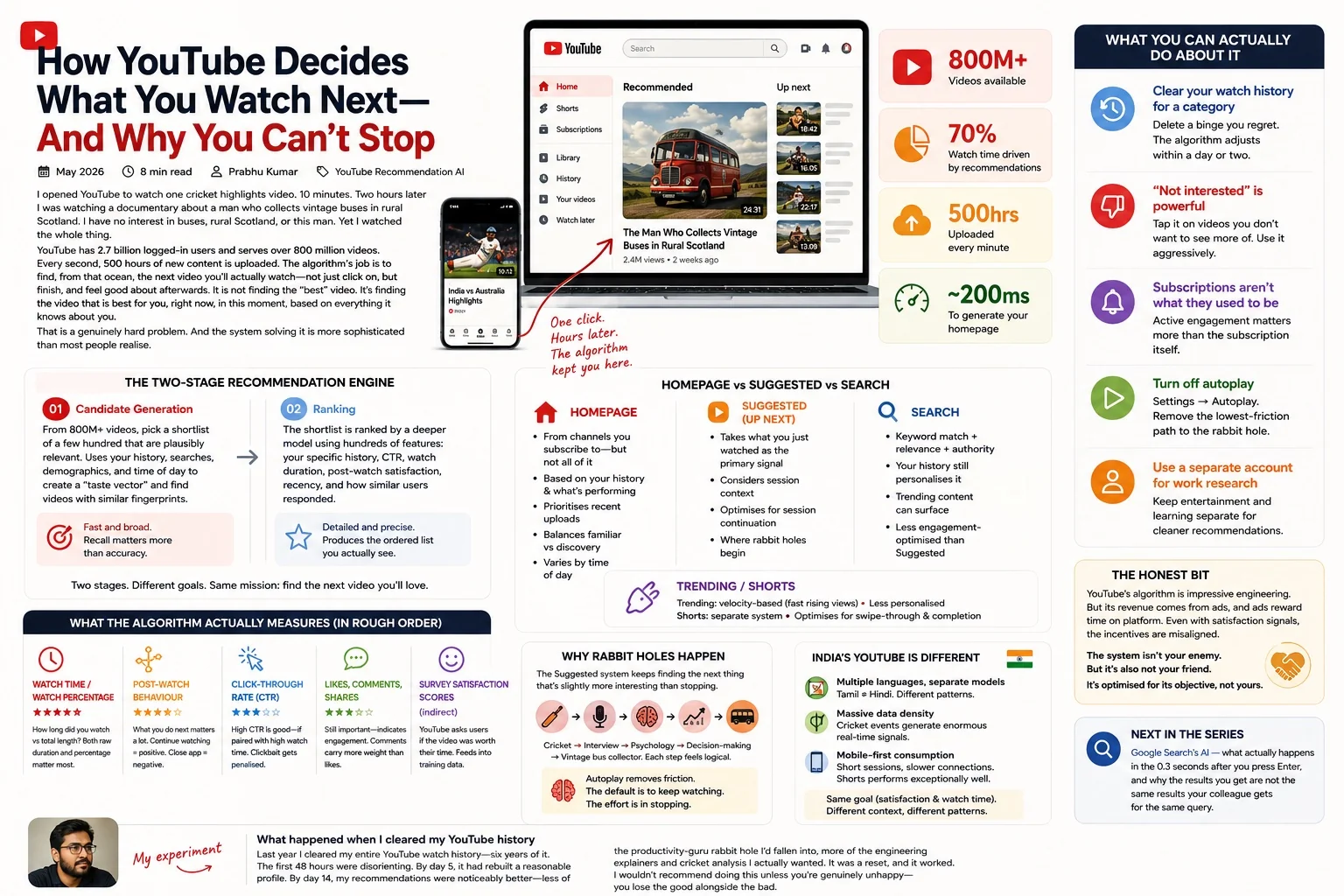
I opened YouTube to watch one cricket highlights video. 10 minutes. Two hours later I was watching a documentary about a man who collects vintage buses in rural Scotland. I have no interest in buses, rural Scotland, or this man. Yet I watched the whole thing.
YouTube has 2.7 billion logged-in users and serves over 800 million videos. Every second, 500 hours of new content is uploaded. The algorithm's job is to find, from that ocean, the next video you'll actually watch — not just click on, but finish, and feel good about afterwards. It is not finding the "best" video. It's finding the video that is best for you, right now, in this moment, based on everything it knows about you.
That is a genuinely hard problem. And the system solving it is more sophisticated than most people realise.
In this article
It's Not About Views or Likes
The most persistent myth about YouTube's algorithm is that it promotes videos with the most views, the most likes, or the most subscribers. That was roughly true in 2012. It hasn't been true since 2016, when YouTube made a significant change: they shifted the primary metric from clicks to watch time.
The problem with optimising for clicks is obvious in hindsight — it created a race to make the most outrageous thumbnails possible. "I QUIT YOUTUBE FOREVER (not clickbait)" got millions of clicks. People would open the video, realise it was garbage, and leave after 8 seconds. YouTube was rewarding bad content because views ≠ satisfaction.
Watch time fixed part of that. Then they added something more nuanced: post-watch satisfaction signals. After watching a video, did you open another? Did you come back to YouTube tomorrow? Or did you close the app and feel vaguely annoyed? YouTube has been running surveys — literally asking users "was this video worth your time?" — and feeding those responses into training data. They call this "responsible watch time."
The current system isn't just trying to keep you watching longer. It's trying to keep you satisfied enough that you come back tomorrow. That's a subtly different objective — and it shapes everything downstream.
The Two-Stage Recommendation Engine
YouTube's algorithm has two distinct phases, which they described in a research paper published by Google Brain in 2016. The system is more complex now, but the architecture remains the same.
From 800 million+ videos, the system picks a "shortlist" of a few hundred that are plausibly relevant to you. It uses a deep neural network that takes your watch history, search history, demographic signals, and the time of day as inputs and produces a vector — essentially a mathematical fingerprint of what you're likely to want. It then finds videos whose "fingerprints" are closest to yours. This stage is fast and broad. Accuracy matters less here; recall matters more. Better to include 10 good candidates that get filtered later than to miss them.
The shortlist of a few hundred videos is now ranked by a second, much more detailed neural network. This model considers hundreds of features: your specific history with this channel, how recently you've watched similar content, how other people with similar histories responded to this video, the video's click-through rate, its average view duration, the time since upload, and the post-watch satisfaction scores from survey data. This stage produces the ordered list of recommendations you actually see.
The key insight is that you can't just run one very accurate model over 800 million videos — it would take too long. The two-stage approach trades off precision at stage one for speed, then maximises accuracy at stage two on a manageable shortlist. It's the same architecture used by Netflix, Spotify, and most large-scale recommendation systems.
Homepage vs Suggested vs Search — Three Different Systems
People often talk about "the YouTube algorithm" as if it's one thing. It's three different things running different objectives.
🏠 Homepage
- Shows content from channels you subscribe to — but not all of it
- Selects based on your watch history and what's performing well
- Prioritises content uploaded recently
- Balances familiar vs discovery — new creators can appear here
- Varies by time of day (work commute vs late night)
▶️ Suggested (Up Next)
- The most powerful and most addictive system
- Takes what you just watched as the primary signal
- Also considers session context (what you've watched today)
- Optimises for session continuation — keeping you in
- Where the "rabbit hole" effect comes from
🔍 Search
- Closer to a traditional search engine
- Keyword match + relevance + authority signals
- Your history still affects it (personalisation layer)
- Trending content can surface even without search history
- Less engagement-optimised than Suggested
🔥 Trending / Shorts
- Trending: mostly velocity-based (fast rising views)
- Less personalised than the others
- Shorts uses a separate recommendation stack
- Shorts optimises for swipe-through and completion
- Shorts is YouTube's direct response to TikTok's model
What the Algorithm Actually Measures
Here are the signals that matter most in the ranking stage, in rough order of weight:
How long did you watch vs the video's total length? A 3-minute video watched to completion is worth more than a 30-minute video watched for 5 minutes, in many models. Both raw duration and percentage matter — long videos with high completion signal genuine quality.
After this video ended, what did you do? Immediately watch another (session continues — strong positive signal), close the app (weak negative signal), or watch something unrelated (neutral)? The algorithm traces the chain reaction downstream from each recommendation.
If 1 in 10 people shown a thumbnail clicks it, that's a 10% CTR. High CTR is good, but only if it's paired with high watch time. A clickbait video with 15% CTR and 20% watch duration will score lower than a quality video with 6% CTR and 80% watch duration. YouTube is explicitly optimising against misleading thumbnails.
Engagement signals still matter — they indicate that the content prompted a response. Comments in particular are valued because writing one takes deliberate effort. But these are weaker signals than watch time because they're much easier to game.
YouTube surveys a subset of users after watching: "Was this video worth your time?" These scores feed into training data over time. Individual videos don't get rated by enough users to matter in isolation, but patterns across creators and categories shape what the model learns to recommend.
"Posting at the right time makes your video go viral"
Upload time affects how many of your subscribers are active when you post — that's real. But the algorithm doesn't boost videos just because they're new. It continuously re-evaluates performance. A video uploaded on Tuesday morning can start getting pushed weeks later if it suddenly starts performing well in a new cohort. The algorithm is always-on, not a launch window.
Why Rabbit Holes Happen
The "Suggested" system — the panel on the right, or the autoplay queue — is where the rabbit hole begins. Here's the mechanical reason it's hard to stop.
When you finish a video, the algorithm looks at your current session (what you've watched today), the video you just finished, and what other people who watched that video went on to watch. It finds the intersection: content that's similar enough to feel natural, but different enough to feel like discovery.
The problem is that "natural and slightly different" keeps moving. You watched cricket highlights → you watch a behind-the-scenes interview → you watch a sports psychology video → you watch a general psychology video → you watch a video about decision-making → you're watching a man explain why he collected 47 vintage buses. Each step felt logical. The cumulative drift was enormous.
The algorithm didn't trick you. It just kept finding the next thing that was fractionally more interesting than stopping — which is a surprisingly low bar at 11pm when you're already horizontal.
Autoplay makes this worse by removing friction. Without it, you'd have to actively choose to watch the next video. With it, the default is to keep watching. The cognitive effort is in stopping, not in continuing.
YouTube knows this. They've added features like "Take a break" reminders and bedtime reminders specifically because the autoplay loop was generating complaints. Whether you use these features is, of course, up to you — but the algorithm itself isn't tuned to remind you that you have work tomorrow.
India's YouTube Is Different
India is YouTube's largest market by users — over 450 million monthly users — and the recommendation engine behaves noticeably differently here, for a few reasons.
Language is the big one. YouTube serves content in Hindi, Tamil, Telugu, Bengali, Kannada, Malayalam, Marathi, and over a dozen other languages. The recommendation system can't rely purely on collaborative filtering ("people who watched X watched Y") because watch patterns in Tamil are almost entirely separate from watch patterns in Hindi, even for the same broad genre. YouTube has had to build language-specific sub-models.
Data density is another factor. A cricket match between India and Australia generates more simultaneous watch events on Indian YouTube than most Western events generate in total. The algorithm learns very quickly what Indian audiences respond to during live sports moments — and those lessons generalise fast into adjacent content.
The mobile-first consumption pattern also shapes things. The majority of Indian YouTube is watched on phones, often on slower connections, often in short sittings of 15–20 minutes rather than 2-hour desktop sessions. Shorts performs exceptionally well here — and the algorithm has clearly registered this. When I watch from my phone in India, I see more Shorts and regional language content in my Suggested than when I watch from a laptop.
One thing that hasn't changed: the algorithm still optimises for watch time and satisfaction. The signals are the same. Only the content pool and viewing patterns differ.
What You Can Actually Do About It
A few things that genuinely affect what you see — not tips, but things I've actually tested.
Clear your watch history for a category. If you go into History → Search and watch history and delete a block of videos from a binge you regret, the algorithm adjusts quickly. You'll see less of that content within a day or two. It doesn't forget forever, but it recalibrates.
"Not interested" is more powerful than you think. When you tap "Not interested" on a recommended video, you're giving a strong negative signal not just about that video but about that creator and topic. Use it aggressively on content you don't want to see more of — it works.
Subscriptions aren't what they used to be. Subscribing to a channel doesn't guarantee you see their content — it just means they get included in the candidate pool. If you stop watching a channel's videos, the algorithm will quietly stop showing them to you even though you're still subscribed. Active engagement (opening the channel, finishing videos) matters more than the subscription itself.
Turn off autoplay. It's in Settings → Autoplay. This one change removes the lowest-friction path to the rabbit hole. You can still choose to watch the next video — you just have to choose it.
Use a separate account for work research. If you use YouTube for professional learning, mixing it with entertainment viewing creates a muddled recommendation profile. A separate account (even a free one) gives the algorithm a clean signal to work with.
The Honest Bit
YouTube's recommendation system is genuinely impressive engineering. The two-stage neural network, the satisfaction surveys, the responsible watch time framing — these are real attempts to build something that doesn't just maximise your time-on-app but also makes you feel good about the time you spent.
But there's a structural problem that no amount of good engineering fully solves: YouTube's revenue comes from advertising, and advertising revenue is correlated with time on platform. Even with satisfaction signals in the training data, there is always going to be pressure — institutional, not conspiratorial — to keep you watching a little longer.
I'm not saying YouTube is manipulating you. I'm saying the incentives are misaligned, and that misalignment has real effects on what gets recommended. Emotionally engaging content — whether that's uplifting or outrage-inducing — tends to generate more watch time and more engagement signals than calm, informative content. That's not a conspiracy; it's what the data says, and the algorithm learns from the data.
The system isn't your enemy. But it's also not your friend. It's a very sophisticated tool that's trying to achieve its objective — which is not quite the same as yours.
Last year I cleared my entire YouTube watch history — six years of it. The first 48 hours were disorienting. My homepage was basically nothing: trending videos, a few channels I'd recently subscribed to, a lot of blank space. I kept seeing content that was very generically "tech" because that's what my search history implied about me.
By day 5, it had rebuilt a reasonable profile. By day 14, my recommendations were noticeably better — less of the productivity-guru rabbit hole I'd fallen into, more of the engineering explainers and cricket analysis I actually wanted. It was a reset, and it worked.
I wouldn't recommend doing this unless you're genuinely unhappy with your recommendations — you lose the good alongside the bad. But it showed me that the algorithm really does learn from you, and that you can teach it something different if you're deliberate about it.
Next in the series: Google Search's AI — what actually happens in the 0.3 seconds after you press Enter, and why the results you get are not the same results your colleague gets for the same query.