📱 Social Media AI · Instagram
How Instagram Decides What You See — And What It Buries
A few months ago I noticed something odd. I followed a photographer friend of mine — someone I actually know in real life, text regularly, and genuinely want to see posts from. I hadn't seen anything from them in weeks. Not because they stopped posting. They'd posted 12 times. I'd seen zero of them.
Meanwhile, a cooking account I followed by accident two years ago and never interacted with was showing up every other day. A Reel from someone I'd never heard of, from a topic I have passing interest in, appeared three times in a row.
None of this is random. There is a specific set of AI models making these decisions — right now, for your account, based on your last 90 days of behaviour. Understanding how they work doesn't require a computer science degree. It just requires someone to explain it plainly. That's what this is.
First, the uncomfortable maths
If you follow 400 people and they each post once a day, that's 400 posts competing for your attention. Instagram decides you will realistically scroll through maybe 30–60 of them. So it has to pick. And it picks based on one question: which of these 400 posts are you most likely to meaningfully interact with?
Not "most likely to see." Most likely to pause on, like, save, comment on, or share. Those are very different things — and the distinction matters.
It's not one algorithm — it's five separate ones
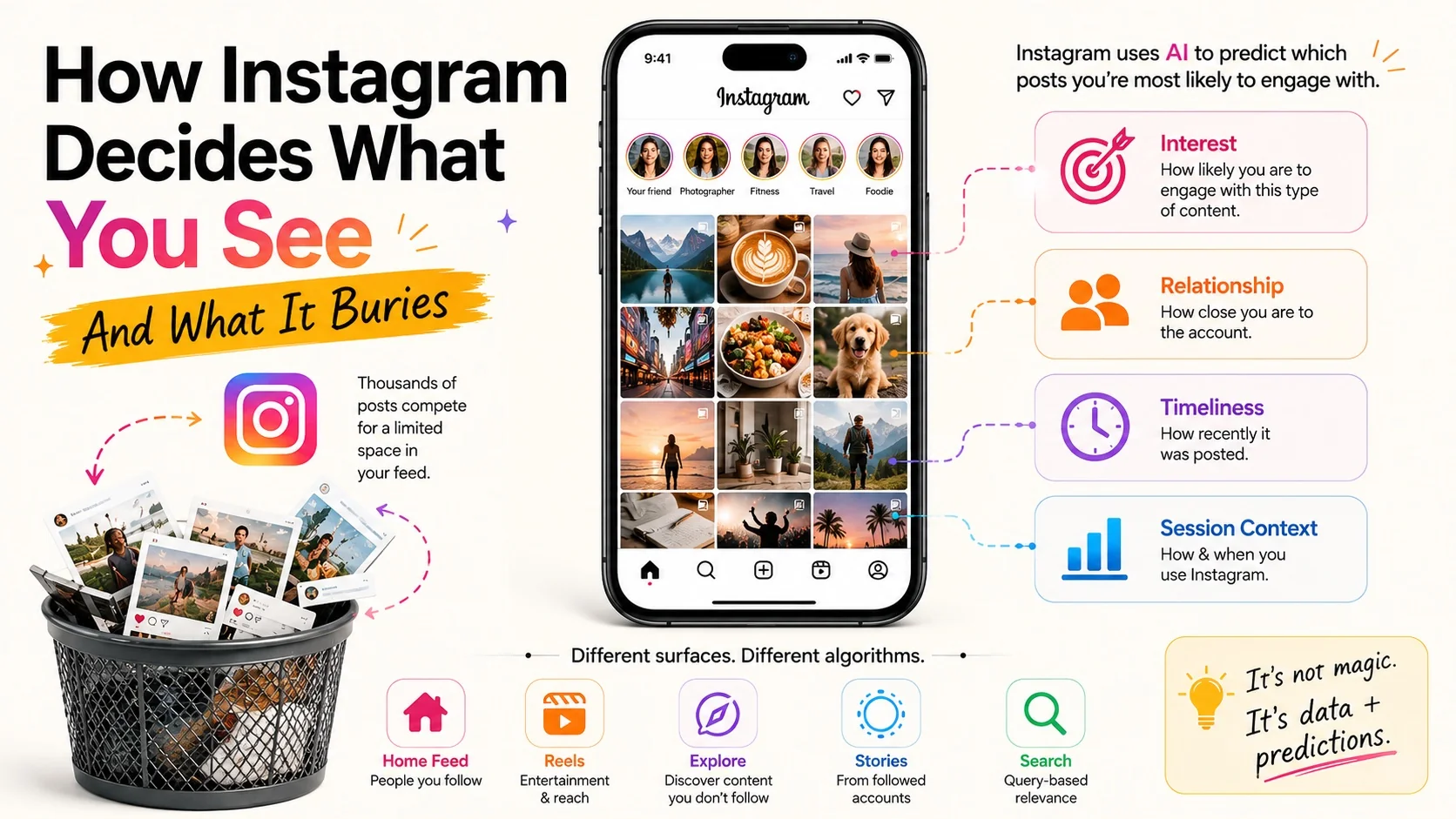
This is where most explanations go wrong. People talk about "the Instagram algorithm" as if it's one thing. It isn't. Instagram has confirmed there are separate ranking systems for each surface in the app:
- Home Feed — posts from accounts you follow, ranked by predicted engagement
- Reels — short videos from both followed and non-followed accounts, prioritising reach and entertainment
- Explore — content discovery from accounts you don't follow, tailored to your interests
- Stories — from followed accounts, ranked by relationship strength and recency
- Search — query-based, with its own relevance model
Each of these runs a different model with different goals. A post that performs well in one doesn't automatically appear in another. A Reel that goes viral on Explore might never appear in the home feeds of even the people who follow that account. That's why creators obsess over "distribution" — because there are five separate distribution channels, each with its own rules.
How your Feed is ranked
For the home feed — the posts from people you already follow — Instagram uses a ranking model built around four main signals. These are the things it measures and weighs for every single post, every time you open the app.
1. Interest Highest weight
How likely are you specifically to interact with this type of content? The model looks at your history with the creator (do you like their posts? comment? reply to their stories?), the content format (do you engage more with photos or videos?), and the topic. If you consistently save food posts and skip travel posts, the model knows — and it adjusts what it shows you even among the people you follow.
2. Relationship High weight
How close are you to this account? Instagram infers relationship strength from things like: have you DM'd this person? Tagged each other in posts? Commented on each other's content in the last 90 days? Viewed their Stories consistently? This is why accounts you interact with frequently — even if they post rarely — stay visible. And why accounts you silently follow slowly disappear.
3. Timeliness Medium weight
How recently was it posted? Newer posts get a boost. But this isn't simply "newest first" — it's weighted against the other signals. A post from a very close account posted 6 hours ago might still outrank a post from a distant account posted 10 minutes ago. Timeliness matters but it's not the main event.
4. Frequency & Session Context Supporting signal
How often do you open Instagram, and how long are your sessions? If you open it every 3 hours, Instagram essentially resets and tries to show you the "best of" what you missed. If you're a heavy user who scrolls for 40 minutes at a stretch, it digs deeper into lower-ranked content because it needs to fill the time. Your usage pattern affects what you see.
💡 The key insight: the algorithm doesn't care about follower count in your feed. A creator with 200 followers who you DM regularly will appear more often than a creator with 2 million followers you've never interacted with. Relationship beats fame, in the home feed.
How Reels are ranked — very different rules
Reels is where Instagram's ambitions get more interesting — and more aggressive. Unlike the home feed which is mostly about people you already follow, Reels is designed to introduce you to accounts you've never seen. The goal here isn't to show you what your network is doing. It's to keep you watching.
The Reels ranking model scores every candidate video on a predicted probability that you will:
- Watch it all the way through (or replay it)
- Like it
- Share it to a friend via DM
- Visit the audio page and use that sound in your own Reel
That last one is interesting. Instagram actively wants Reels to go viral through audio. When a sound gets used in thousands of Reels, the platform gets more content for free. So videos using trending audio get a built-in distribution boost — not because the content is better, but because it benefits Instagram to push them.
There's also a meaningful penalty system. Reels get actively suppressed if they: contain a watermark from another platform (TikTok's logo, for example), are blurry or low resolution, are a photo rather than a video, or have been recycled content that performed poorly before. Instagram is notoriously specific about this. Reposting a Reel you downloaded from TikTok will get buried even if the content is excellent.
The Explore tab — a completely different algorithm
Explore is where the model gets genuinely sophisticated. Everything in Explore is from accounts you don't follow. The algorithm has to figure out what you'd find interesting without the shortcut of "you already chose to follow this person."
It does this in two stages. First, it looks at your interaction history and builds a set of "seed accounts" — people whose content you've engaged with recently. Then it looks at what other people similar to you also engage with. This is called collaborative filtering — the same technique that powers Spotify's Discover Weekly and Netflix's recommendations.
Essentially: Instagram finds thousands of people with similar taste patterns to yours, looks at what they recently interacted with that you haven't seen yet, and uses that as the candidate pool for your Explore page. Then it ranks that pool by predicted engagement.
This is why Explore sometimes feels like it can read your mind. It's not reading your mind — it's reading the minds of 10,000 people who have similar behaviour patterns to you. The prediction is actually about them, not you. It just turns out to be accurate about you too.
The "shadowban" — real, but not what people think
"Instagram is secretly hiding my posts from my followers to punish me"
The idea of a deliberate, targeted ban where Instagram quietly suppresses your account while pretending everything is fine. Very dramatic. Also not really how it works.
What people call a "shadowban" is almost always one of three things:
1. Hashtag filtering. Instagram does filter posts from certain hashtags — especially ones frequently associated with spam or violating content — from appearing in hashtag search results. If you're using a flagged hashtag, your posts won't show up there. This isn't secret; it's just not well documented.
2. Low engagement signals killing distribution. If your last 10 posts got significantly lower engagement than usual, the algorithm interprets this as "people don't want to see this content" — and it starts showing your posts to a smaller initial audience as a test. If that small audience also doesn't engage, it distributes even less. This compounds. It looks like a ban but it's just the algorithm following its data.
3. Community guideline strikes. If your content was reported and reviewed, your account can have restrictions placed on it — including reduced distribution. Instagram does tell you when this happens, in the Account Status section of the app. It's not secret.
The real lesson: there's no mysterious shadow force targeting your account. There's an engagement model that responds to signals. If your signals are weak, your distribution shrinks. That's uncomfortable but it's also fixable — because you can change your signals.
Why the ads feel weirdly accurate
This is the part that makes people uncomfortable. You mentioned something to a friend. You didn't search for it. You just said it out loud — and then the ad appeared.
I want to be direct here: Instagram does not listen to your microphone for ad targeting. This has been tested repeatedly by researchers and the results are consistent — there's no evidence of it, and the data overhead would be enormous.
What actually happens is more subtle and in some ways more unsettling. Instagram's ad targeting model has access to:
- Every account you follow, every post you've liked or saved, every profile you've visited
- Your location data (if permitted), including where you shop and who you're near
- Your activity on any website or app that has a Meta Pixel embedded in it — which is a huge portion of the internet
- Data from Facebook if your accounts are connected
- Lookalike audiences — if you match the profile of people who bought a product, you'll see that product's ads even if you never showed direct interest
That last point is why the coincidences feel so accurate. You didn't search for running shoes. But your fitness app shared data with Meta's advertising network. You visited a sports retailer's website three times last month. You follow five fitness accounts. The model matched you to a customer profile — and the ad appeared. It's not magic. It's a very large dataset with very good pattern matching.
What you can actually do with this knowledge
I'm not going to tell you to delete Instagram. I'm on it. Most people I know are on it. What I will say is that knowing how this works gives you a few practical options that most people don't take because they don't realise they exist.
To see more of specific accounts: interact with them. Not just likes — comments and DMs are weighted much higher. If there's someone you actually want to see posts from, leave a real comment once in a while. The model will register the relationship and show you more of them.
To reset a stale feed: go through your following list and unfollow anyone you haven't meaningfully engaged with in 6 months. Fewer signals from irrelevant accounts means the model has more room to surface the ones you actually care about.
To reduce ad targeting: go to Settings → Ads → Ad Preferences → Ad Topics, and mark topics you don't want to see. More usefully: Settings → Accounts Centre → Your Information and Permissions → Your Activity Off Meta Technologies — this shows you (and lets you disconnect) the off-platform tracking. Doing this won't make ads disappear but it will make them less eerily accurate.
To stop a Reel from following you: use the "Not Interested" option (hold down on the Reel). This is a direct training signal — the model actually uses it. One or two taps isn't enough; do it consistently for a week and you'll notice a real difference in what Reels show you.
After I understood how Instagram's feed ranking actually worked, I stopped being annoyed by it and started using it deliberately. I went through my following list and cut it from 380 to about 90 people I genuinely want to hear from. My feed changed almost immediately — not because Instagram rewarded me for it, but because I gave the model less noise to work through.
The algorithm isn't your enemy. It's optimised for Instagram's business, not your happiness — those are different things — but once you understand the inputs it responds to, you can push those inputs in a direction that works better for you. That's the actual value of understanding this stuff: not outrage, just control.
WhatsApp's AI Knows You're Being Scammed Before You Click
WhatsApp can't read your messages. So how does it still catch spam? The answer is surprisingly clever.