💬 WhatsApp · Privacy + Safety AI
WhatsApp's AI Knows You're Being Scammed Before You Click
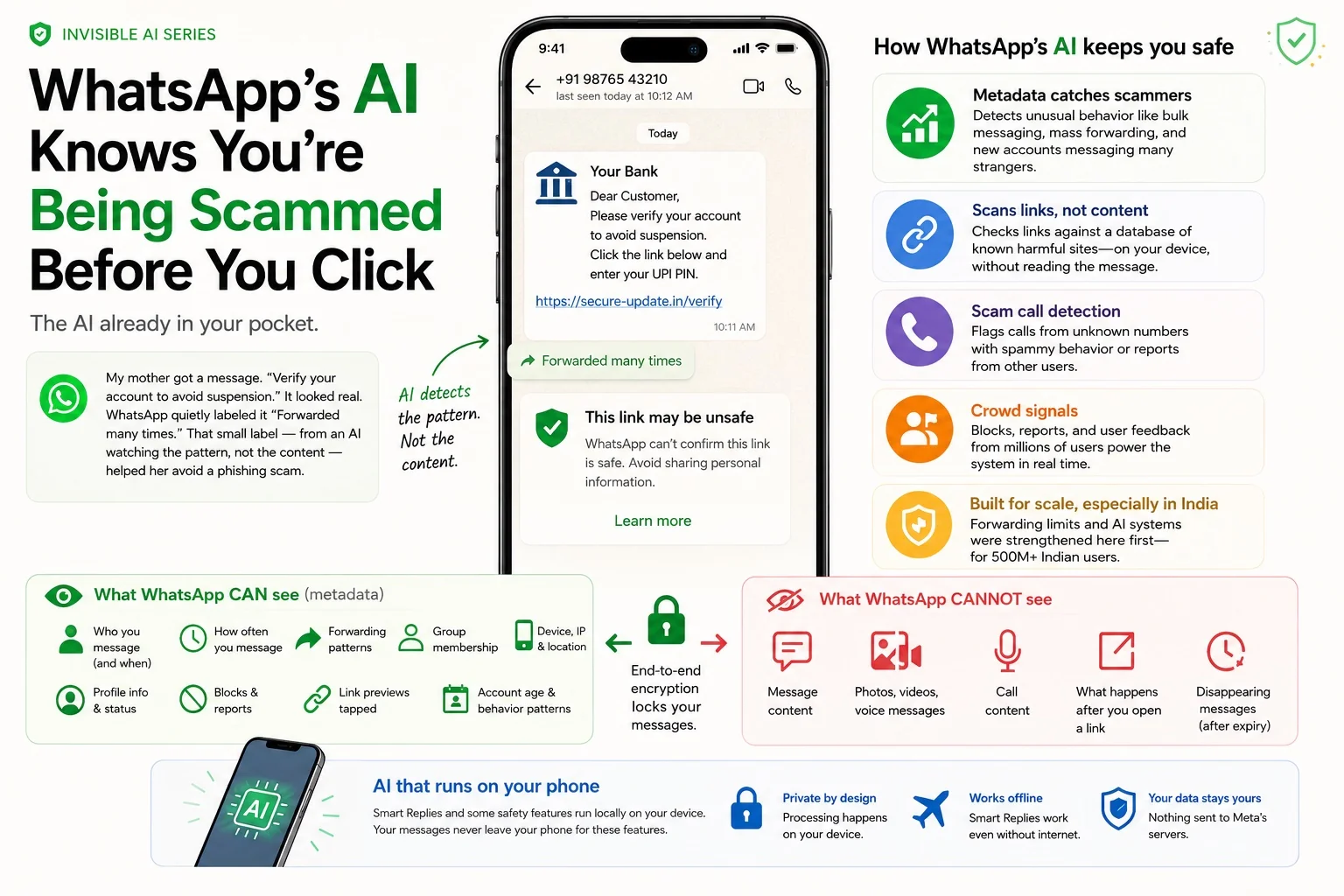
My mother got a WhatsApp message last year. Someone claiming to be from her bank, asking her to "verify" her account by clicking a link and entering her UPI PIN. The message looked genuine — bank logo, formal language, even her first name. She forwarded it to me before clicking.
What she didn't notice was the small label WhatsApp had quietly placed on the message: "Forwarded many times." That label exists because an AI had already flagged the message as suspicious — not by reading it, but by tracking how it moved. It had been forwarded to thousands of people in a short window. That pattern, not the content, was the signal.
She didn't click. The link was a phishing page. The "bank" was a scammer in another state.
This is the puzzle at the heart of WhatsApp's safety system. The app promises you that nobody — not Meta, not governments, not WhatsApp itself — can read your messages. End-to-end encryption means the content is locked the moment you send it and only unlocked on the recipient's device. So how does WhatsApp still manage to catch scammers, flag spam, and warn about suspicious links?
The answer is that reading message content is not the only way to understand what's happening.
The paradox: encrypted but not invisible
Here's an analogy that helped me explain this to a non-technical friend. Imagine the post office. They've promised to seal every letter in a tamper-proof envelope — nobody can read what's inside. But they can still see: who sent it, who it's going to, how heavy it is, whether the same envelope design was sent to 10,000 different addresses in one day, and whether the return address has been flagged before.
That outer information — who, when, where, how often, to how many people — is called metadata. And metadata, it turns out, tells you an enormous amount about what's happening inside an encrypted system without needing to break the encryption at all.
💡 The key insight: WhatsApp cannot read your messages. But it can see the pattern of how those messages move. And scam messages have very distinctive patterns — patterns that are hard to fake even if the content looks completely legitimate.
Exactly what WhatsApp can and cannot see
- Your phone number and account registration details
- Who you message and when (not what)
- How many people you message per hour/day
- Whether a message has been forwarded and how many times
- Group membership — how many groups you're in, how large they are
- Your device information and IP address
- Whether a link was tapped (not what you did after)
- Profile photo, status text, about section
- Whether you've been blocked or reported by other users
- The text of your messages
- The content of your photos, videos, or voice messages
- Your call content (WhatsApp calls are also encrypted)
- What happens after you open a link
- Message content in archived chats
- Disappearing messages once they've disappeared
That left column is more powerful than it looks. Most people think "they can't read my messages, so I'm invisible." But the behavioural pattern that emerges from the left column is often enough to identify a scammer with high confidence — without ever reading a single word they sent.
How metadata catches scammers
Think about how a real scam operates. One person — or a small team — is sending the same fraudulent message to thousands of people. They need to do this at scale because their conversion rate is low. Maybe 1 in 500 people falls for it. So they need to reach 50,000 people to get 100 victims.
That behaviour creates a metadata fingerprint that is almost impossible to hide:
Volume anomaly
A normal WhatsApp user sends maybe 50–200 messages a day to a handful of contacts. A scam account sends thousands of messages per hour to numbers it has never contacted before. The model flags accounts that exhibit this pattern — even if every individual message looks legitimate.
Forwarding velocity
This is what caught the message my mother received. When the same content — even encrypted — gets forwarded by hundreds of different people to hundreds of new recipients in a short time window, the system detects the forwarding chain. It can't read what's being forwarded. But it can see the forwarding pattern. That's why the "Forwarded many times" label exists — it's a signal from the AI, not a human editorial decision.
Block and report signals
When users block or report an account, those actions are not encrypted — they're sent directly to WhatsApp as a clear signal. If an account gets reported by 50 different people in one hour, the AI doesn't need to read any messages to know something is wrong. The aggregated reports are the evidence.
Account age and behaviour patterns
A freshly registered number that immediately starts messaging thousands of strangers is suspicious by definition. Legitimate users build up contact history gradually. The model scores new accounts based on how their early behaviour compares to the baseline of real users — and flags ones that look like they were created for bulk messaging.
How it scans links without reading them
This one surprised me when I first looked into it. When you receive a link in WhatsApp, the app shows you a preview — the page title, a thumbnail image, a short description. That preview has to be generated somehow. And the process of generating it is also where safety checks happen.
Here's how it works: WhatsApp doesn't read the URL from your encrypted message. Instead, when you choose to preview or tap a link, your device fetches that preview. At that point, the URL is checked against a database of known malicious domains. This check happens on your device, not on Meta's servers — so the actual link content stays private.
WhatsApp also maintains a list of domains that have been reported as phishing or malware sources by users across the platform. When a new domain starts generating reports, it gets added to this list and future links to it show a warning. The warning you sometimes see — "This link may be unsafe" — is coming from a collaborative filtering system powered by millions of user reports, not from someone at Meta manually reviewing URLs.
How scam call detection works
WhatsApp calls are encrypted too — the audio is completely private. So how does the app warn you about potential spam calls?
Again, it's metadata. When you get an incoming call from a number you've never contacted, from an account that:
- Was registered recently
- Has no mutual contacts with you
- Has called a large number of different people in the last 24 hours
- Has been reported as spam by previous call recipients
…the app flags it. The "Possible Spam" label you see on some calls is a real-time score from these signals. No call content is analysed. The pattern of calling behaviour is enough.
In India specifically, this has become one of the more practically useful WhatsApp features — because OTP scams and "bank verification" call frauds often use WhatsApp as the delivery mechanism. The scammers call from fresh numbers, make a high volume of calls in a short window, and get reported quickly. That reporting loop is what powers the detection.
Why India is a special case — and why WhatsApp built for it
500 million users. The world's largest WhatsApp market.
India has more WhatsApp users than any other country. Which also means it has more WhatsApp scam victims than any other country. The "KYC update" fraud, the "your account will be blocked" phishing, the fake customer care number scam, the UPI refund trick — most of these operate primarily through WhatsApp because that's where everyone is.
Meta has had to build India-specific responses into WhatsApp's safety systems. The forwarding limit — a maximum of 5 forwards per message, reduced to 1 forward for messages already labelled "Forwarded many times" — was originally introduced in India in 2018 after forwarded misinformation contributed to real-world violence. The AI flagging system was partially built in response to the scale of fraud activity that India's user base generates.
When WhatsApp's safety team talks about scale, India is the benchmark. If a system can work at India's volume and linguistic diversity, it can work anywhere.
The AI running on your phone, not Meta's servers
One thing most people don't know: some of WhatsApp's AI features run entirely on your device. Not on a server somewhere. On the phone in your hand.
Smart Replies — the suggested responses that appear when someone sends you a message — are generated by a small language model running locally. WhatsApp trained this model and shipped it as part of the app. When you get a message, your phone processes the text locally and generates suggestions. None of that goes to Meta's servers. The model has been on your device since you last updated the app.
This is a deliberate architecture choice. Running the model locally means the message content never leaves your device — maintaining the encryption promise. It also means Smart Replies work without a data connection. The tradeoff is that on-device models are less capable than large server-side models. But for short contextual replies, a small on-device model is more than good enough.
"Smart Replies means WhatsApp is reading my messages"
Not quite. The Smart Reply model runs on your phone. The message text is processed locally by your device's processor — it doesn't go anywhere. Think of it like your phone's autocorrect: it reads what you're typing to suggest the next word, but nothing leaves the device. Same principle, different task.
What this actually means for your privacy
Here's where I want to be honest rather than just reassuring.
Your message content is genuinely private. End-to-end encryption is real, it works, and even Meta cannot read your chats. That part of WhatsApp's privacy promise is solid.
But metadata is not nothing. Who you talk to, when, how often, in which groups — this paints a detailed picture of your life even without a single word of content. Researchers have demonstrated repeatedly that metadata alone can reveal relationship status, political beliefs, health conditions, and daily routines with high accuracy.
WhatsApp's privacy policy is explicit that this metadata is shared with Meta and can be used for "safety, integrity, and security purposes" — which includes the fraud detection we've been talking about. It can also be used for advertising purposes across Meta's platforms, though not within WhatsApp itself (which has no ads).
The honest summary: for the vast majority of people, in the vast majority of situations, WhatsApp's encryption provides real and meaningful privacy protection for message content. The metadata collection is a real trade-off — but it's the same trade-off you make with every communication service you've ever used. The difference is WhatsApp at least makes it visible in its privacy policy, which is more than most.
After spending time understanding how this system actually works, my view changed in an unexpected direction. I came in mildly sceptical — "they say it's encrypted but what does that really mean?" — and came out genuinely impressed by the engineering.
The forwarding label that saved my mother from a phishing attack wasn't a human decision. It was a metadata anomaly detector running at scale across 500 million Indian users. The fact that it works — that it correctly flagged a scam message without reading a single word of it — is a genuinely elegant solution to a hard problem.
That doesn't mean I trust Meta unconditionally with my metadata. I don't. But I do think the content encryption is real, the safety system is genuinely useful, and the trade-off is clearer than most people realise — once you actually understand what's being traded.
How Instagram Decides What You See — And What It Buries
Back to the Invisible AI hub
Google Maps, Spotify, Netflix, UPI fraud detection and more — all coming in this series.