The Problem We Were Solving
Gas safety training in industrial environments has historically relied on classroom instruction and printed manuals. The problem is obvious — you cannot safely simulate a gas leak, valve failure, or hazardous exposure scenario in a real industrial facility for training purposes. Traditional training leaves workers underprepared for the visceral reality of a real emergency.
VR changes this fundamentally. We can put workers inside a photorealistic gas facility, simulate hazardous scenarios, and let them make mistakes — and learn from them — in complete safety. The simulation can be repeated as many times as needed, on any device, without any risk.
What We Built
The Gas Safety VR Training Simulator covered three core training areas:
- Hazard identification — workers navigate a virtual gas facility and identify safety violations, exposed pipelines, and equipment faults
- Safe handling procedures — interactive step-by-step workflows for valve operation, pressure checking, and safety equipment usage
- Emergency response simulation — timed scenarios where workers must execute correct emergency procedures under pressure
Technical Implementation
Physics-Based Interactions
The most technically demanding aspect was implementing realistic physics-based interactions with industrial equipment — valves, pipelines, pressure gauges, and safety equipment. Workers needed to physically grab, turn, and operate virtual equipment in ways that felt authentic. This required careful use of Unity's XR Interaction Toolkit combined with custom physics scripts for valve rotation resistance and pressure system simulation.
Guided Training Workflows
We implemented a step-by-step guidance system that tracks user performance through each training module. The system detects correct and incorrect actions, provides real-time audio feedback, and logs performance data for supervisor review. Workers receive a compliance score at the end of each module.
Performance Optimisation for Standalone VR
Running a photorealistic industrial environment on a standalone Meta Quest headset at 72fps is a significant optimisation challenge. We used Unity's URP with custom shader optimisation, aggressive LOD systems, occlusion culling, and texture atlasing to hit our performance targets. This was one of the most intensive optimisation projects I've worked on.
Tech Stack
Challenges & How We Solved Them
- Tracking accuracy on standalone hardware — Meta Quest controller tracking occasionally drifted during precise valve interactions. We implemented a snapping system that assists correct positioning without removing the physical challenge of the interaction.
- Realistic hazard simulation without inducing discomfort — simulating gas leaks and emergency scenarios needed to feel urgent without causing VR discomfort. We used audio design heavily rather than visual effects to create urgency.
- Latency in interaction feedback — any delay between physical controller movement and virtual object response breaks immersion. We optimised the interaction response pipeline to achieve sub-20ms feedback on all interactions.
Results & Reception at GITEX Dubai 2024
The solution was showcased at GITEX Dubai 2024 — one of the world's largest technology events — to strong stakeholder appreciation. Industry visitors from the energy and industrial sectors responded particularly positively to the realism of the hazard scenarios and the assessment system's ability to provide compliance-ready training records.
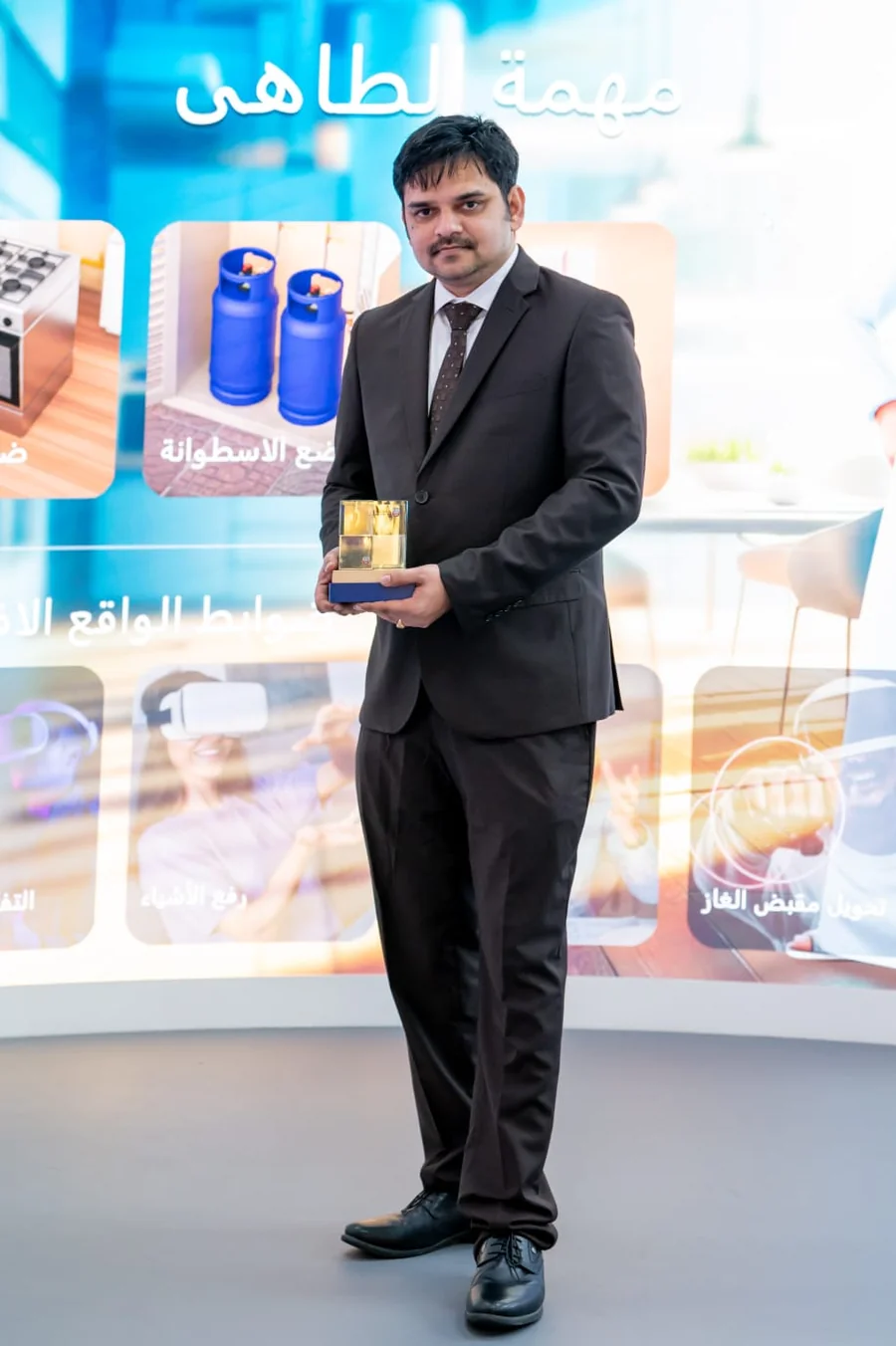
The curved display behind shows the live VR training module interface in Arabic. The text visible includes: مهمة الطاهي (Chef's Mission), ضع الأسطوانة (Place the Cylinder), رفع الأشية (Lift the Object), and مقبض الغاز (Gas Handle) — all interactive training steps from within the VR experience.
GITEX Global is one of the world's largest technology exhibitions, held annually in Dubai. Being showcased at GITEX 2024 represented significant industry validation for the project.
Inside the Simulation — Chef's Quest
The gas safety training experience was built around a narrative simulation called "Chef's Quest" — an interactive journey set inside a kitchen environment that teaches safe LPG gas cylinder handling through hands-on VR interactions. The setting was deliberately chosen to be familiar and relatable: a home kitchen where the user plays the role of a family member learning safe gas practices alongside a character named Ali and his father.
Rather than a lecture-style training module, the simulation placed the trainee inside a real scenario and asked them to make decisions — with immediate feedback when those decisions were wrong. This is the core principle of effective VR safety training: learning through doing and experiencing consequences in a safe virtual environment, rather than reading about them.
The User Journey
The simulation followed a storyboard designed around the full LPG safety procedure. The trainee progressed through the kitchen environment, interacting with virtual objects at each stage:
The player enters the kitchen environment and must look around to understand the space — identifying where appliances are placed, where the LPG cylinder is located, and what the safe placement zones look like. This teaches spatial awareness before any action is taken.
The trainee must drag and drop the burner stove to a position they judge to be safe. Three drop zones are available — one correct, two wrong. An incorrect placement highlights in red. If wrong, Ali's father calls and asks the trainee to explain their reasoning — reinforcing the learning rather than just penalising the mistake.
The trainee interacts with the LPG cylinder — learning correct placement, connection procedures, and safe storage positioning. The simulation covers the compliance requirements for cylinder placement that are mandated by UAE safety regulations.
Later steps in the journey introduce gas leak scenarios. The trainee must identify the correct emergency response — shutting off the gas handle, ventilating the space, and following the evacuation procedure. These are the highest-stakes moments in the training and the ones most likely to save a real life.
Educational panels appear at key stages with compliance guidelines, safety regulations, and maintenance schedules — including cylinder renewal timelines and storage responsibilities. A quiz component validates knowledge retention before the trainee can progress.
On completing all 17 steps, the system generates a performance score and compliance record. Every decision made during the simulation is tracked — providing the organisation with a training completion record that meets regulatory reporting requirements.
Why a Kitchen Narrative?
The choice to set the simulation in a kitchen with a family character was deliberate. Gas safety incidents in the UAE and the wider Middle East are most commonly domestic — involving residential LPG cylinders in home cooking environments. A scenario that felt familiar and personal was more likely to create genuine behavioural change than an abstract industrial setting. The character of Ali's father calling to challenge incorrect decisions added a social accountability layer that purely mechanical feedback cannot replicate.
Key Lessons for XR Developers
- Narrative makes safety training stick — users who are invested in a story remember the safety lesson attached to it. A named character asking "why did you place the burner there?" creates more retention than a red error message.
- Wrong answers need to teach, not just penalise — three placement zones with one correct answer is a design choice. The wrong zones need to be plausible enough that choosing them is an honest mistake, not an obvious failure.
- Performance budget first — on standalone Meta Quest, decide your polygon and draw-call budget before any 3D asset is created. Retrofitting optimisation after production is far more expensive than designing for it from the start.
- Domain knowledge is not optional — building a gas safety simulator without understanding UAE LPG compliance requirements would produce a visually convincing but procedurally incorrect experience. Domain expertise shapes every interaction decision.
Frequently Asked Questions
What platform was the Gas Safety VR Simulator built for?
The simulator was built for Meta Quest standalone headsets using Unity URP. It was optimised to run at 72fps on the Quest hardware without requiring a PC connection, making it deployable in industrial training environments without complex setup.
How does VR compare to traditional safety training?
VR safety training allows workers to experience hazardous scenarios that cannot be safely replicated in real environments. Research consistently shows higher knowledge retention from immersive experiential learning compared to classroom instruction. The ability to repeat scenarios, track performance data, and provide consistent training regardless of instructor variation are additional advantages.