The Problem: Needle Phobia in Children
Fear of needles (trypanophobia) affects a significant proportion of children and leads to real clinical problems — children who resist vaccination, increased procedure difficulty for healthcare workers, and lasting anxiety associations with medical care. Traditional distraction techniques (toys, screens, parental reassurance) work to varying degrees but don't provide the deep attentional engagement that VR can achieve.
VR distraction therapy is clinically validated — research shows that immersive VR can significantly reduce both perceived pain and anxiety during medical procedures by occupying the brain's attention so completely that pain signals receive less processing priority. I built Vax-e-Kids to leverage this.
The Experience Design
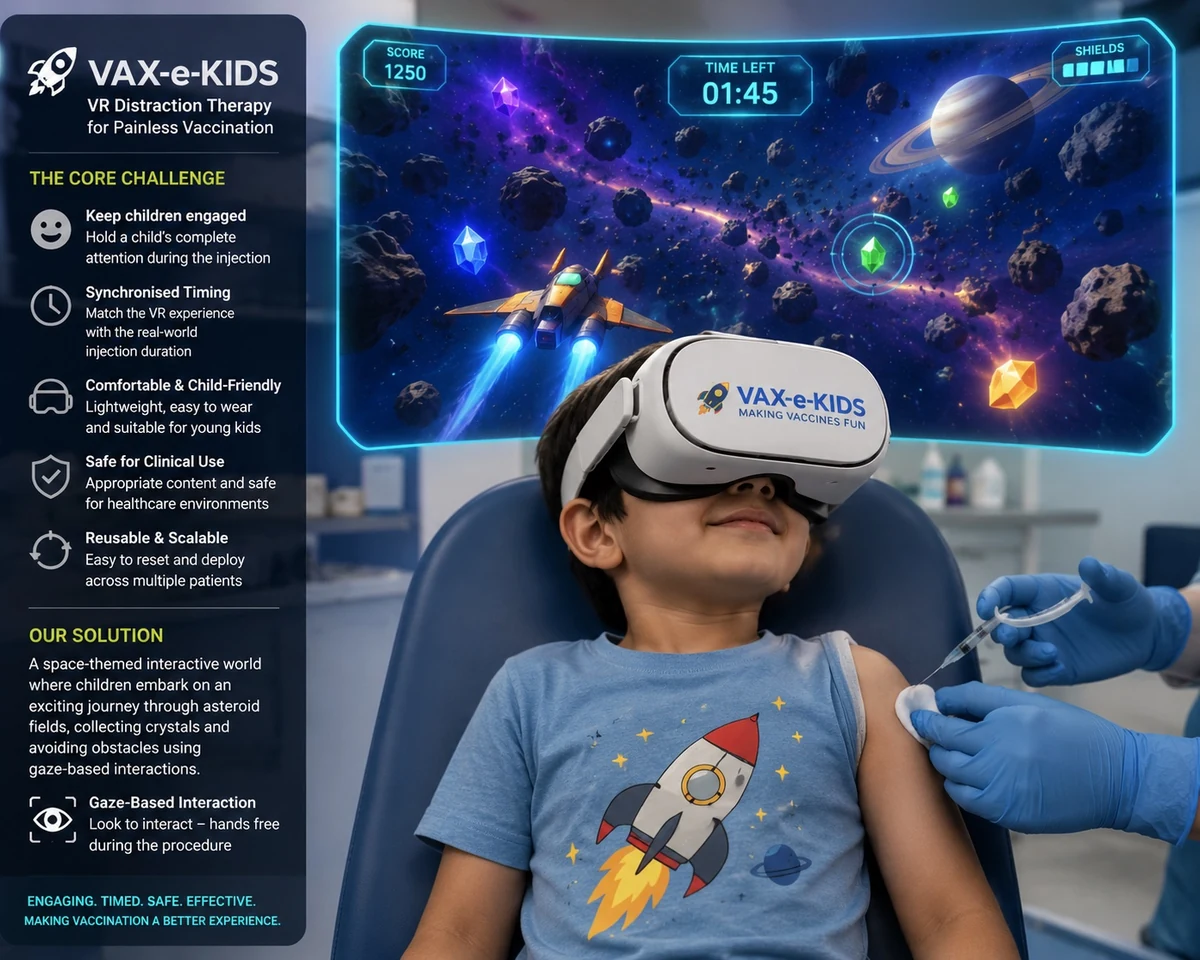
The core challenge of Vax-e-Kids was designing a VR experience that:
- Was engaging enough to hold a child's complete attention during the injection
- Was timed to synchronise with the real-world procedure duration
- Was comfortable for young children to wear and use
- Was safe and appropriate for a clinical healthcare environment
- Could be reset and deployed repeatedly across many patients
I created a space-themed interactive world — children fly through an asteroid field, interacting with elements by looking at them (gaze-based interaction, keeping hands free for the medical procedure). The experience was timed to the typical injection duration, with the most engaging interactive moments coinciding with the injection itself.
Technical Implementation
Gaze-Based Interaction Design
Standard VR controller-based interaction wasn't appropriate — children's hands needed to be accessible to healthcare workers, and controllers are challenging for young children. I implemented a gaze-based interaction system where looking at interactive objects triggers responses after a short dwell time. This kept children's attention fully engaged with the visual experience.
Procedure Timing Synchronisation
The most delicate design challenge was synchronising the VR experience timeline with the real-world medical procedure. I built a healthcare worker control interface that allows the clinical team to trigger key experience moments at appropriate times — the peak engagement moment was triggered to coincide with the injection itself.
Comfort and Safety in a Clinical Setting
VR headsets in clinical environments face unique challenges — hygiene between patients, quick fitting for children of different sizes, stability during the procedure, and emergency access for clinical staff. I worked closely with the client's clinical team to address every one of these constraints in the hardware setup and software design.
Tech Stack
How AI Tools Helped Build This
Vax-e-Kids had some specific technical challenges where AI tools contributed meaningfully during development.
Gaze-based interaction logic — implementing dwell-time gaze interaction cleanly in Unity, with appropriate visual feedback, cooldown handling, and edge cases for rapid gaze movement, was one of those tasks where ChatGPT was useful for generating a solid starting implementation. The clinical setting meant this needed to be reliable and predictable under conditions where a child might move their head unexpectedly. ChatGPT produced a working gaze interaction system that I then refined extensively through testing with real children.
Timing engine architecture — the synchronisation between the VR experience timeline and the healthcare worker control interface required a clean event system that could be triggered externally without breaking the experience flow. Claude was useful for reasoning through the architecture here — specifically how to decouple the experience timeline from the trigger events so that clinical staff could control timing without needing to understand the internal state of the Unity application.
Clinical documentation — working with a pharmaceutical company requires careful documentation of technical specifications, interaction design rationale, and clinical validation methodology. ChatGPT handled the first drafts of these documents, which I then edited with the clinical and regulatory specifics. On a project where the end users are children in a medical setting, documentation quality matters.
This project also reinforced something that remains true regardless of AI tool capability: the decisions that made Vax-e-Kids work — the gaze interaction timing that feels right for a frightened child, the peak engagement moment that coincides with the injection, the way the space world responds to draw attention at the critical moment — came from understanding child psychology, clinical constraints, and what VR can and cannot do. No AI tool can substitute for that.
Impact & Reflection
Vax-e-Kids represents the highest expression of what XR technology can do — not just making work more efficient or training more effective, but directly reducing suffering and improving a human experience that almost everyone finds difficult. The clinical feedback from healthcare workers was that children emerged from the experience surprised the procedure was complete, with significantly reduced distress compared to standard approaches.
This project is also a reminder of why XR developers need genuine domain expertise. Building for a clinical setting required understanding of hygiene protocols, child psychology, clinical workflow, and regulatory considerations that no AI tool can substitute for. The technical skills got the project built — the domain understanding made it work in the real world.
Frequently Asked Questions
Does VR distraction therapy actually work for children?
Yes — there is substantial clinical research supporting VR distraction therapy for pediatric procedures. Multiple studies show statistically significant reductions in both self-reported pain scores and observable distress behaviours when VR distraction is used during needle procedures. The immersive nature of VR provides deeper attentional engagement than 2D screen-based distraction.
What makes designing VR for children different from adult users?
Children have smaller heads (IPD and headset fit issues), shorter attention spans requiring higher engagement density, different cognitive development stages affecting interaction design, and greater sensitivity to VR discomfort. Clinical settings add hygiene, safety, and accessibility constraints. Every assumption you make for adult VR users needs to be reconsidered for pediatric applications.