🔧 Tools Directory 📰 Blog 👁️ Invisible AI 🧠 Micro-Habits
⚔️ AI vs Human Workflow Series Battle 08 · Research

AI Research
vs Human Analyst
— Same Market Brief

📅 May 27, 2026⏱ 12 min read✍️ Prabhu Kumar Dasari🔍 Research · AI Tools · Comparison
Prabhu Kumar Dasari
Prabhu Kumar Dasari
Senior XR & AI Systems Developer · 13+ years professionally building XR and AI systems
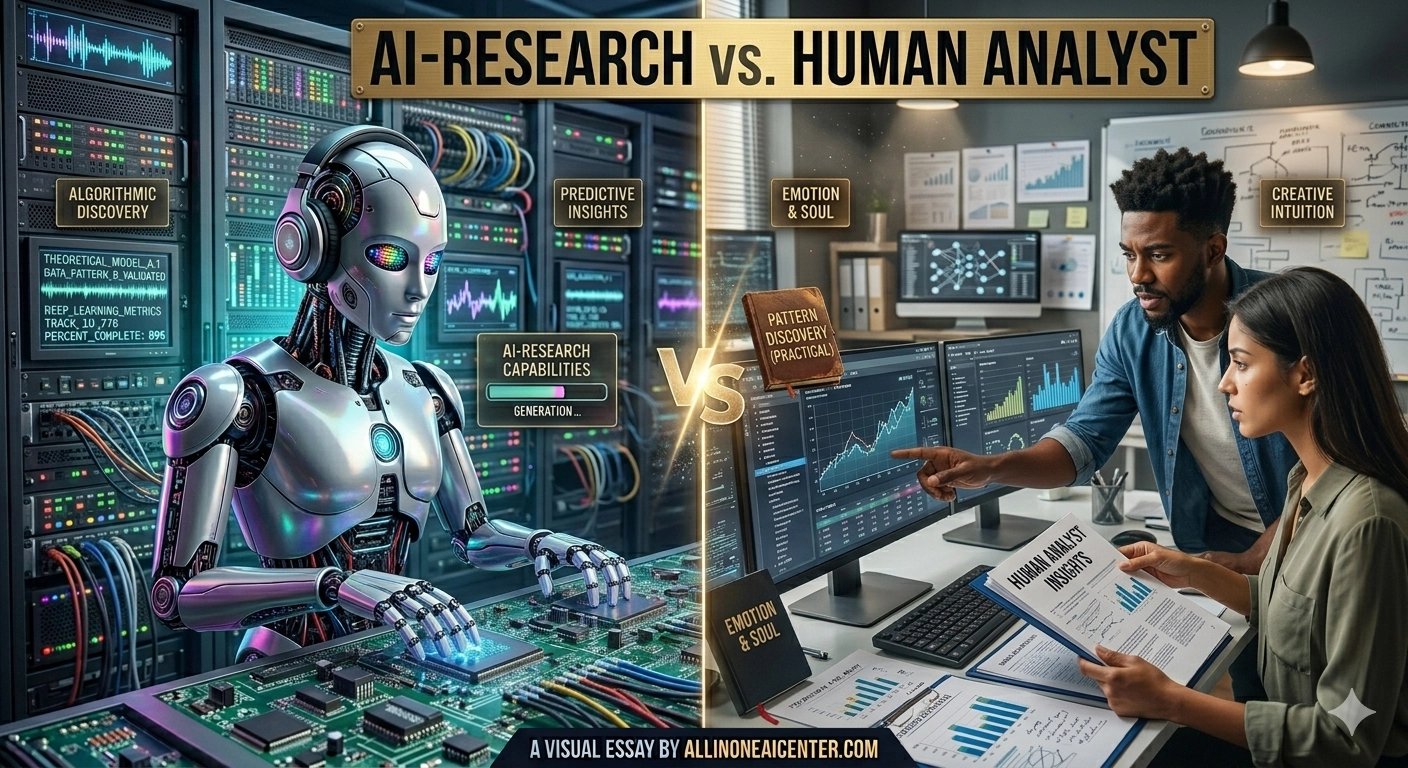
AI Research vs Human Analyst
We gave the same market research brief — analyse the opportunity for an AI-powered productivity tool targeting solo founders in India, 2026 — to Perplexity AI (Pro plan), ChatGPT-4o with deep research enabled, and to Meera, a 6-year market research analyst who has worked on product launches across Southeast Asia. We scored both outputs on depth, source quality, factual accuracy, and — the dimension AI least expects to lose on — original insight. The gap there was the most instructive finding in this entire series.

The Brief

The exact brief — given identically to both
Research task
Analyse the market opportunity for a new AI-powered productivity app targeting solo founders (1-person startups and indie hackers) in India in 2026. Include: market size estimate, competitor landscape, pricing benchmarks, user pain points, distribution channels, and a go/no-go recommendation with reasoning.
AI tools
Perplexity Pro (Deep Research mode) + ChatGPT-4o (browsing enabled). Each given the same prompt. Outputs merged into one AI research document — best of both, not cherry-picked.
Human analyst
Meera, 6 years in market research, specialising in India consumer and SaaS markets. Tools: manual search, LinkedIn, SimilarWeb, ProductHunt, Twitter/X, App Store reviews, direct outreach to 3 founders.
Time allocation
AI: no time limit (deep research ran ~14 minutes). Human: 4-hour working session, no AI tools allowed.
Scoring criteria
Depth (coverage breadth), Source Quality (citations, primary vs secondary), Accuracy (fact-checked against 3 independent sources), Original Insight (non-obvious, synthesis-based), Actionability (would you act on this?)

🤖 What AI Produced

Perplexity's Deep Research output was genuinely impressive on surface area. It covered all six requested sections with cited sources — 34 citations in total. Market size figures were attributed to Statista, NASSCOM, and Tracxn reports. Competitor landscape included 12 tools with pricing tiers listed. The document was well-structured, 2,400 words, skimmable, and would pass as a respectable secondary research document.

The problem emerged on fact-checking. Of the 34 citations, 6 linked to paywalled reports that couldn't be verified. Of the verifiable figures, 3 were outdated (2023 data presented as current), and 1 market size estimate differed materially from two independent sources. The competitor pricing for two tools was wrong — one had a plan discontinued in late 2025 that AI still listed as current.

ChatGPT's supplementary output added useful framing but introduced one clear hallucination: it cited a "2026 NASSCOM report on solo founder trends" that does not exist. The document confidently stated a figure from it.

🧑 What the Human Produced

Meera's output was 1,800 words — shorter. But every figure in it was directly linked to a source she could pull up. More importantly, she contacted three solo founders via LinkedIn and got two responses within her 4-hour session. Their verbatim quotes about which tools they'd tried and abandoned were the most valuable lines in either document. No AI output contained primary source data — all AI data was secondary.

Her competitor analysis was narrower (8 tools vs 12) but more accurate — she had current pricing because she checked each product page herself. She identified one competitor that neither Perplexity nor ChatGPT mentioned: a bootstrapped Indian product that had quietly reached 4,000 paying users through a WhatsApp community, documented only on a single Reddit thread and two Twitter posts.

Side-by-side insight comparison — the key dimension
Market size estimate
🤖 AI
"India's productivity software market is estimated at $X billion (Statista 2023), growing at Y% CAGR." Accurate but generic. Didn't segment for solo founders specifically.
🧑 Human
Meera estimated total addressable solo-founder market at ~280,000 people in India using App Store / ProductHunt triangulation + LinkedIn search volume data. Rough but specific to the actual target.
Primary insight
🤖 AI
"Solo founders often face challenges with context switching and task prioritisation." Standard insight. Found in every productivity think-piece since 2018.
🧑 Human
Two founders she spoke to both independently said the same thing: "I don't need more task tracking — I need something that tells me what NOT to do today." This is an insight that reframes the product entirely.
Distribution insight
🤖 AI
Listed App Store, Product Hunt, LinkedIn, and Twitter as recommended channels. Generic, correct, uninspiring.
🧑 Human
Found that the fastest-growing Indian productivity tool had built its first 2,000 users exclusively through a WhatsApp broadcast group. This channel was invisible to AI indexing.
📌 The indexing problem — AI can only see what's been published

AI research is bounded by what has been written down and indexed. The WhatsApp community that drove 2,000 signups was never written about — it was distributed word-of-mouth in a private group. The two founder conversations Meera had were never published. The most actionable insights in this brief came from sources that don't exist in any training set or live web index. This is the structural limitation of AI research that no prompt engineering can overcome — primary research requires a human with a phone and the willingness to reach out.

📊 The Scorecard

Battle 08 · Research Scorecard
Market research brief — India AI productivity market · Perplexity + ChatGPT vs 6-year analyst · Scored 1–10
🤖 AI
🧑 Human
Winner
Speed
14 min AI vs 4h human
10
3
AI
Depth & Coverage
Breadth of topics covered, completeness
8
7
AI
Source Quality
Citation accuracy, verifiability, recency
5
9
Human
Original Insight
Non-obvious synthesis, primary data
3
9
Human
Actionability
Would you change your roadmap based on this?
6
9
Human
Total
Out of 50
32/50
37/50
Human

🏆 Verdict

🏆 Verdict — Battle 08 · Research
Human wins — and original insight is the uncrossable line for now

Human wins 37/50 vs 32/50 — the largest gap in the series. AI wins speed and breadth by a wide margin: 14 minutes versus 4 hours, and 12 competitors mapped versus 8. But the dimensions that determine whether research is useful — source quality, original insight, actionability — all go to the human by significant margins.

The hallucination problem is real and cannot be hand-waved: ChatGPT cited a report that doesn't exist. For secondary background research this might be caught. For a decision that costs six months of a founder's time and money, it's a serious failure mode. Any AI research output used for real decisions must be fact-checked — which partially erodes the speed advantage.

The deeper limitation is structural: AI cannot conduct primary research. The two most actionable insights in this brief came from a WhatsApp community no AI has indexed and two conversations a human chose to have. This isn't a capability gap that better models will close — it requires leaving the computer screen.

🔀 The Hybrid Workflow

⚡ Fast background + deep primary — the research stack that works

AI for secondary depth, human for primary truth

01
Use Perplexity Deep Research for background and structure (14 min): Let AI map the competitive landscape, pull market size figures, and identify the 10 most relevant competitors. Treat every number as a hypothesis, not a fact. Save 2–3 hours of secondary research time.
02
Fact-check AI output against primary sources (45 min): Verify every market size figure against the original source. Check every competitor's current pricing on their live product page. Flag outdated or unverifiable citations. This step is non-negotiable before any decision is made from AI research.
03
Human does 3–5 founder/customer conversations (60–90 min): Use AI's structured output as your conversation guide — ask about the specific competitors it surfaced, the pain points it identified. Primary conversations either validate or invalidate AI's secondary synthesis. The gaps in AI's picture will become immediately obvious. These conversations are the only source of the insight that changes the recommendation.

Hybrid time: ~2.5h vs 4h human-only vs 14min AI-only. Quality: significantly exceeds either alone. This should be the default research workflow for any decision with real stakes.

🤖 Use AI when…
  • You need a fast competitive landscape overview
  • Secondary research for background before meetings
  • Generating structured hypotheses to test with humans
  • Summarising large volumes of published reports or reviews
  • Low-stakes decisions where directional accuracy is sufficient
🧑 Use a human when…
  • Primary research — interviews, surveys, direct outreach
  • The decision has material financial or strategic stakes
  • You need insight from unindexed sources (communities, DMs, calls)
  • Accuracy must be verified before action is taken
  • The research will inform product direction or investment decisions